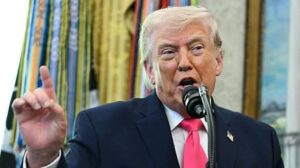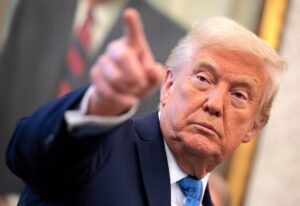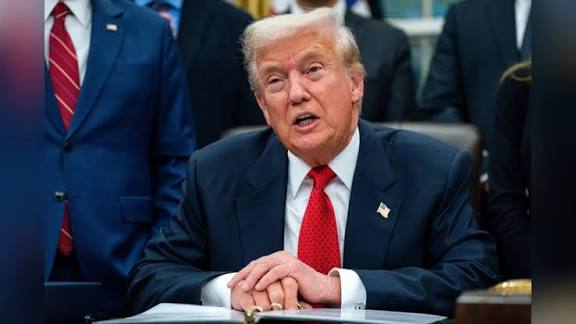
US President Donald Trump is meeting leaders of the Democratic Republic of Congo and Rwanda at the White House – watch live at the top of the page
Foreign leader visits are usually accompanied by considerable fanfare and a West Wing greeting – but not today, says our White House reporter. We caught no glimpse of the leaders going inside
DR Congo’s President Felix Tshisekedi and Rwanda’s Paul Kagame are in Washington to sign a peace deal aimed at ending a decades-long conflict in the region
An agreement was signed by the two countries’ foreign ministers back in June, but each side has accused the other of violating the terms. Tshisekedi and Kagame will now endorse the accord
Ahead of the summit, there has been an escalation in fighting in resource-rich eastern DR Congo between government forces and rebels believed to be backed by Rwanda
The US has been trying to broker peace in war-torn DR Congo to attract Western mining investments
Donald Trump is hoping that the peace deal will provide access to minerals in eastern DRC.
The BBC was recently given access by the M23 rebels to a huge mining site in the region that is vital to the production of the world’s mobile phones.
Thousands of miners dotted the landscape covered with pits and tunnels.
Many were deep underground digging up ore with shovels while others hoisted sacks of extracted rock containing coltan, a key ingredient in making mobile phones.
At least 40% of the mineral’s global supply comes from DR Congo and some of the key mining areas are now under the control of the M23.
Bram Verelst, a DR Congo researcher with the South Africa-based Institute for Security Studies think-tank, describes the deal as significant from a diplomatic perspective.
But he adds: “There is currently no ceasefire in place, and the M23 rebellion continues to expand and consolidate its control.”
The conflict is spreading across the region and increasingly impacts and involves Burundi, which remains outside all peace initiatives.
“The signing ceremony is unlikely to alter this situation, though there is some small hope it could increase accountability on Congolese and Rwandan leaders to honour their commitments,” he says.
“The inclusion of Burundi (and Kenya) as a guarantor is also a welcome step towards more regional inclusivity. But much more needs to be done for a more inclusive peace process. Labelling war as peace will not change the reality and suffering on the ground.”
Still, the “signing shows that progress is being made, and both sides are still interested in talks”, Prof Jason Stearns, a Canada-based political scientist who specialises in the region, tells the BBC.
“It does not actually address or make much progress in terms of the substance of the peace deal. Most of the substance will be addressed in what they call the protocols, which are supposed to be negotiated after this signing.”