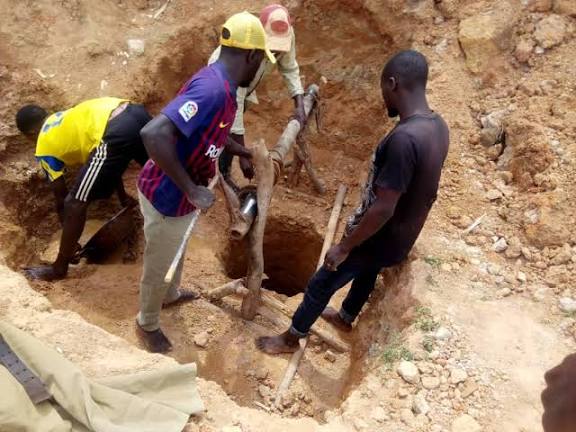
The Miners Association of Nigeria says banning mining activities in the country is not the solution to security challenges in the country.
The association made this known in a statement jointly signed by its National President, Dele Ayankale and its National Secretary, Sulaiman Liman, on Monday in Abuja.
The News Agency of Nigeria recalls that the Northern States Governors’ Forum recently called for the suspension of mining activities for six months following the abduction of school children and killings in some states.
They identified illegal mining as a key driver of insecurity and stated that the suspension would allow for a comprehensive audit and revalidation of all mining licences in consultation with state governments.
Nonetheless, MAN’s President said that only illegal mining had been linked to fueling terrorism and other security challenges, not legal operations, and decried that the ban would hurt legal miners while giving room to illegal operations.
Ayankale argued that previous bans on mining as a strategy to curb insecurity had not yielded positive outcomes, as seen in the 2019 ban on mining activities in Zamfara, saying the negatives outweigh the positives.
He said, instead, banditry, kidnappings and terrorism escalated in the state and extended to neighbouring states of Katsina, Kaduna, Niger, and Kebbi, among others.
It is the disorderly, illegal mining that is conducted without licences and government regulations and control that practices money laundering and fuels insecurity.
“A clear distinction must be made between legal and illegal mining. Therefore, stigmatising mining as the cause of insecurity is a misnomer,” he explained.
He stressed that the ban would be unjust and a serious disservice to legal miners and their employees, leading to mass unemployment, worsening multidimensional poverty, alongside insecurity.
The victims of such bans, he said, were usually legitimate stakeholders, as illegal miners mostly linked with terrorists would still have access to mineral resources due to the government`s poor logistics and personnel to enforce compliance.