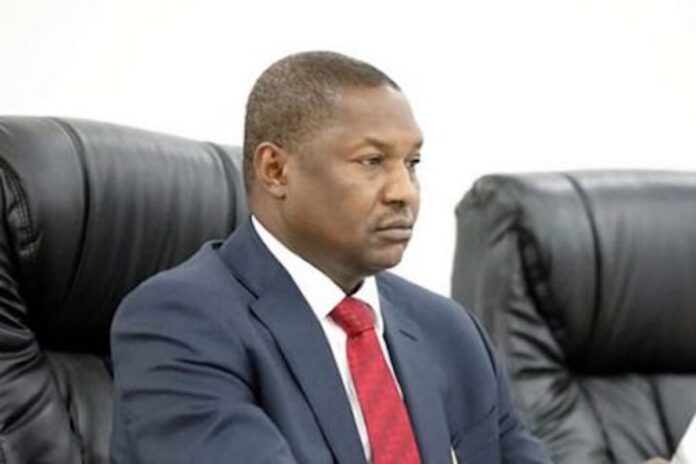
Former Attorney-General of the Federation, Abubakar Malami, has again landed in EFCC custody as investigators revisit questions surrounding the recovery of part of the Abacha loot.
Malami was first invited last week and released after hours of grilling, insisting he had nothing to do with the controversial transactions. Now, his fresh detention has ignited a political firestorm.
In a lengthy rebuttal, Malami vehemently defended his record, stressing he spent his years in office strengthening Nigeria’s fight against terrorism financing, not undermining it.
He said, “My attention has been drawn to a recent publication in which my name was mentioned in connection with allegations of terrorism financing and so-called ‘links’ to persons described as terror suspects or alleged financiers.
“I consider it necessary, in the interest of truth, justice and public record, to make the following clarifications.
“First, I state clearly and unequivocally that I have never at any time been accused, invited, interrogated, investigated or charged by any security, law-enforcement, regulatory or intelligence agency—within or outside Nigeria—in respect of terrorism financing or any related offence.
“Secondly, even the retired military officer cited as the principal source in the said publication categorically admitted that he was not accusing me, or other named individuals, of financing terrorism. His own account, as reported, was limited to a vague assertion that certain suspects allegedly had some form of ‘business’ or ‘institutional’ relationship with various persons. That important clarification was, unfortunately, overshadowed by a headline and framing capable of misleading well-meaning members of the public into drawing inaccurate and damaging conclusions which was unfortunately politically manipulated by my political opponents to create mischievous insinuations implying my involvement in terrorism financing.
“Terrorism financing is a grave crime with devastating consequences for national security and human life. Any attempt—whether by direct allegation or indirect innuendo—to associate an individual with such an offence must be grounded in verifiable facts, due process and lawful findings, not in conjecture, speculation, or guilt by association.
“To suggest that lawful professional or institutional engagements can, without more, be read as evidence of terrorism financing is both mischievous and unjust.
“For the avoidance of doubt, my public record in office stands in direct contradiction to any insinuation of complicity in terrorism financing. During my tenure as Attorney-General of the Federation and Minister of Justice, I worked with other arms of government and relevant institutions to strengthen—not weaken—Nigeria’s legal and institutional framework against money laundering and the financing of terrorism.”
The EFCC has stayed mum on why Malami was picked up again, fuelling speculation and political chatter.
Meanwhile, Malami, who earlier promised updates through his social media pages, has gone silent for four days, leaving Nigerians guessing what comes next.