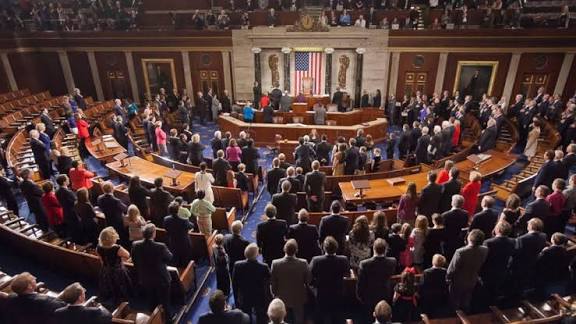
Four Republicans have joined Democrats in the US House of Representatives in a last-ditch effort to extend healthcare subsidies used by millions of Americans that are set to expire at the end of the year.
Enough House members on Wednesday had signed a petition to bring a measure extending the subsidies to a vote, but it has yet to be scheduled. Even if the House approves the measure, it faces an uncertain future in the Senate.
Lawmakers, too, may not move quickly enough to avoid the expiration of the subsidies, and an accompanying rise in premiums for millions.
Without the subsidies, the costs for insurance through the Affordable Care Act (ACA), also known as Obamacare, could more than double.
The moderate Republicans signed what is called a discharge petition, which with enough support, allows members to bring measures to the floor for a full vote.
The House could now be forced to vote in the near-future on a measure that extends Covid-era subsidies for another three years.
Because the chamber will begin its holiday recess on Thursday and lawmakers will not return until the new year, though, it seems likely that any vote on extending the subsidies will take place after they officially expire.
On Wednesday, the House passed a Republican-backed healthcare measure that did not include the subsidies. It aims to lower premiums for some people while raising them for others, starting in 2027, and also would expand access to association health plans where self-employed individuals and small businesses can band together to purchase group insurance. That bill now goes to the Senate.
Democrats were unified in voting against the legislation, and in pushing for a subsidy extension.
All Democrats had signed the discharge petition to force a vote on the subsidies, along with four Republicans – Pennsylvania’s Ryan Mackenzie, Rob Bresnahan and Brian Fitzpatrick, as well as New York’s Mike Lawler.
The group of Republicans said they did not support the extension. Some said they would rather support some kind of extension, than watch the subsidies expire.
“Our only request was a floor vote on this compromise, so that the American People’s voice could be heard on this issue,” Fitzpatrick said in a statement.
“As I’ve stated many times before, the only policy that is worse than a clean three-year extension without any reforms, is a policy of complete expiration without any bridge,” he went on to say.
On Tuesday, House Speaker Mike Johnson said there would be no vote on the subsidies because Republicans could not agree on the best way to extend them. Johnson wanted any extension to be offset with spending cuts.
But 24 hours later, moderate Republicans – many of whom will be in tough re-election battles come November – pushed past Johnson.
Should the measure pass the House, it will go to the Senate, where it currently has some Republican support, but not enough to pass.
When asked when the Senate would vote on the three-year extension, Senate Majority Leader John Thune told reporters on Wednesday: “we’ll cross that bridge when we come to it”.
Should the subsidies expire, the Congressional Budget Office (CBO) projects that there will be an average of 3.8 million more uninsured people each year, on top of healthcare insurance premiums more than doubling for millions.