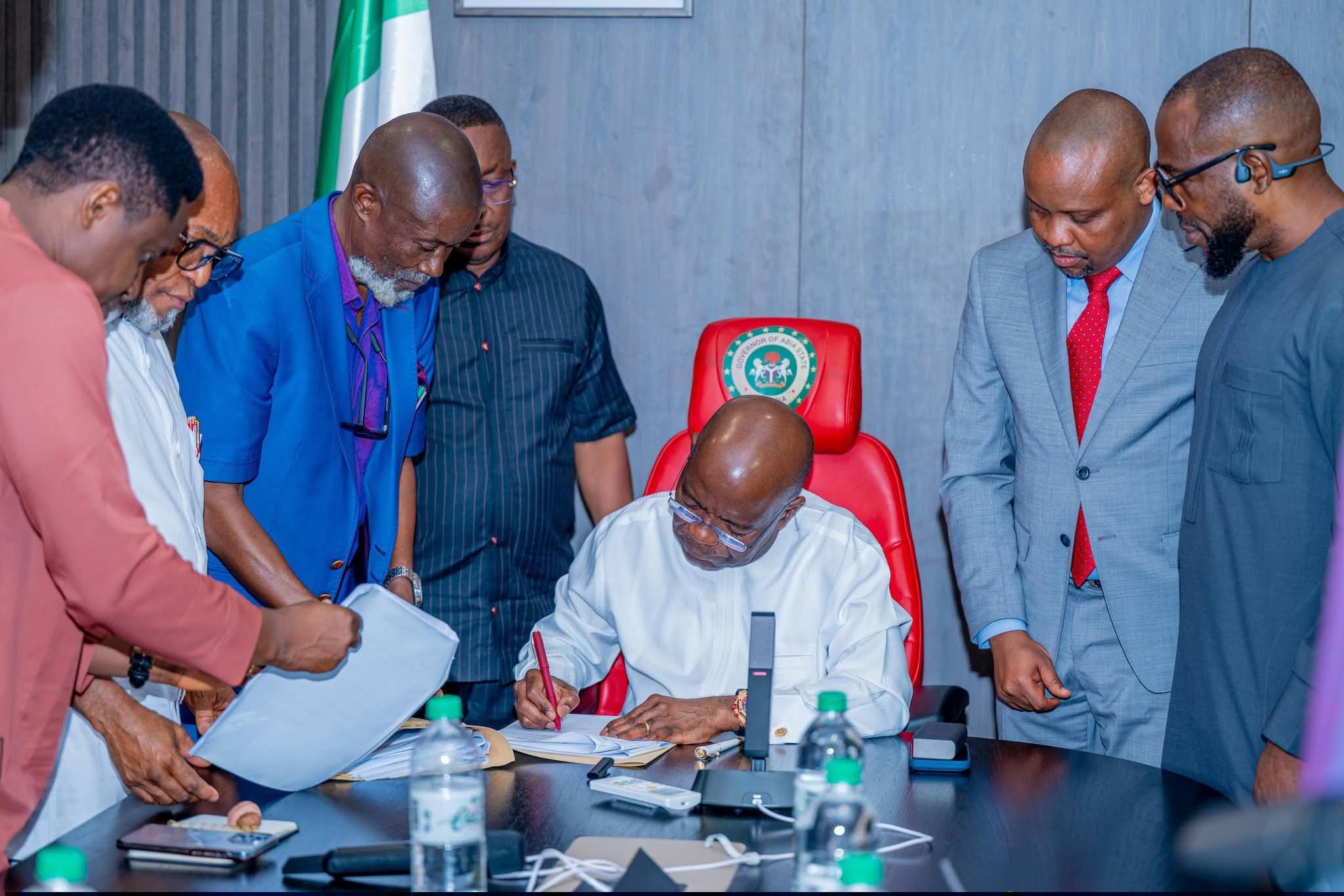
Abia State Governor, Alex Otti, has signed the massive ₦1.016 trillion 2026 Appropriation Bill into law, setting the tone for what he described as accelerated development and renewed economic momentum across the state.
The governor assented to the budget, officially christened the 2026 Appropriation Law at Nvosi in Isialangwa South Local Government Area, moments after its passage by the Abia State House of Assembly.
Hailing the process as a testament to democracy in action, Otti praised the robust engagement between the executive and legislative arms, stressing that transparency and diligence shaped the final outcome.
“I want to start by thanking the team who worked very hard to produce the appropriation bill and dispatched it to the House. More thanks go to the House for expeditiously attending to the bill, crunching the numbers, spending sleepless nights to ensure quick passage of the bill. I want to thank you for the hard work,” Otti said.
The governor noted that lawmakers subjected the proposal to intense scrutiny, describing the exercise as evidence of seriousness and commitment to the welfare of Abians.
“It’s interesting because I kept engaging. I’m very glad that this House pays attention to details, not just a House that would pass a bill without asking questions. I’m not unaware of the engagements going back and forth between the Executive team and the Legislative team.
“And that is what democracy should be about. Questions should be asked and numbers should be scrutinized. Two good heads, they say, are better than one,” he said.
Otti dismissed concerns over the time taken to pass the budget, insisting the delay ultimately strengthened the document.
“That this bill took a little bit of time to pass is also a plus. It shows that some work was being done. And it also puts the executive on his toes to ensure that he continues to up their game, to produce numbers that can be valued for.
“I wasn’t worried when any time I inquired, I understood that they were still crunching the numbers and going back and forth. So I knew that it could only lead to a better outcome. And that is what we have just signed into law,” he further noted.
He disclosed that the budget size remained intact at ₦1.016 trillion, with the capital-to-recurrent expenditure ratio preserved in line with his administration’s development blueprint.
According to the governor, the budget reflects his empowerment-driven philosophy, which prioritises creating an enabling environment for economic growth while sustaining investments in social infrastructure.
“Our definition of empowerment is creating the enabling environment for our people to do their business and do their stuff.
“And then, of course, also implementing and creating social infrastructure in terms of Health, Education, and Environmental issues, having our place clear, other than the roads and the bridges and the other hardcore infrastructure.
“So once you have that overarching view of government, the rest will be details. And I’m happy that we are all going in the same direction,” Otti noted.
Reaffirming his commitment to fiscal discipline, the governor pledged strict adherence to the approved budget, assuring lawmakers that any proposed adjustments would follow due legislative process.
“This is a disciplined government and will stick to the budget that has been approved. And if there is any reason for anything to change, we will still come back to you with a legitimate defence,” he said.
Earlier, Speaker of the Abia State House of Assembly, Emmanuel Emeruwa, described the 2026 budget as a **“Project of Acceleration and New Possibilities,”** declaring that Abia was rising from years of infrastructural and developmental setbacks.
“That is why we are beginning to accelerate. And I do believe that we have started and we are not going to slow down until this place is completely transformed,” Emeruwa said.
He added that Abia’s transformation was attracting attention beyond Nigeria, assuring that the Assembly would remain firmly aligned with the governor’s agenda and would resist any attempt to reverse the state’s progress.