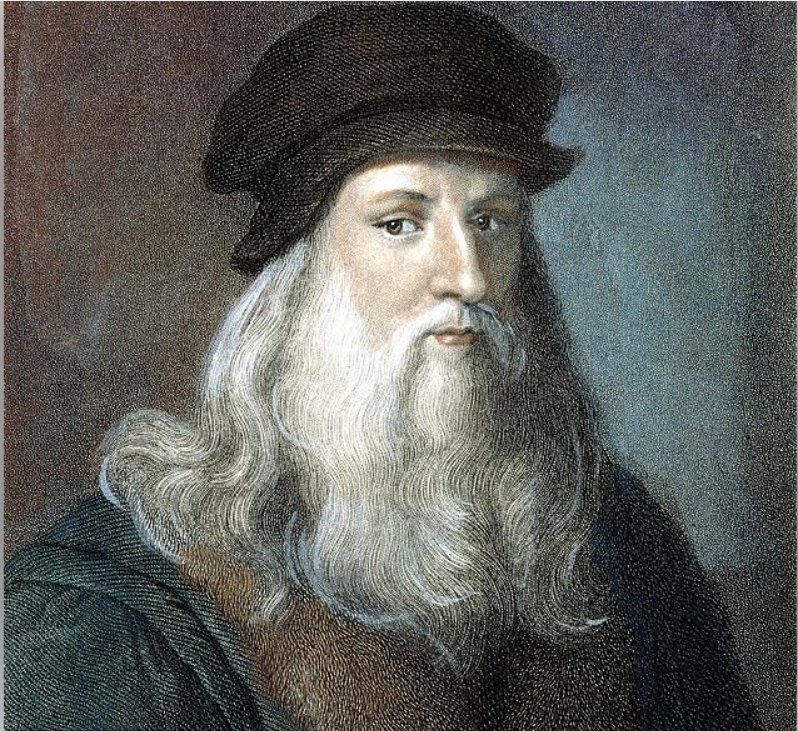
Scientists have found a sample of DNA from a Leonardo da Vinci drawing that could belong to the Renaissance polymath.
In April 2024, researchers working with the Leonardo da Vinci DNA Project swabbed a red chalk sketch titled ‘Holy Child’.
In a new paper, these researchers now argue that DNA extracted from those samples could have been left by da Vinci himself over 500 years ago.
If the DNA can be linked definitively to da Vinci, it could help explain what made him such a unique genius.
This new study uses an analysis of the Y chromosome sequence, a type of DNA which is passed directly from father to son without combining with genes from the mother.
Scientists compared Y chromosome samples extracted from Holy Child with another sample of DNA taken from a letter written by Leonardo’s cousin.
Both the Y chromosome from the painting and the letter belong to a genetic group of people who share a common ancestor in Leonardo’s home region of Tuscany.
Although the scientists say they can’t yet be certain, this discovery could be the first breakthrough towards cracking the code of da Vinci’s DNA.
While famous paintings like the Mona Lisa have been handled and cleaned too often in the last 500 years to retain DNA, da Vinci’s drawings and sketches were more promising.
Co-author Dr Noberto Gonzalez-Juarbe, a biologist from the University of Maryland, told Science: ‘Paper is porous. It absorbs sweat, skin, bacteria, DNA. All of it stays there.’
The researchers gently rubbed the drawing, Holy Child, with a COVID-19 test-like swab to pick up any trace elements of DNA.
There, alongside DNA from the sweet orange trees that grew in Florence, the researchers identified human DNA that could belong to da Vinci.
If it does, scientists believe that it could start to reveal hidden details about this enigmatic figure.
In particular, scientists think that DNA could hold the secret to how da Vinci saw the world differently.
Drawings and sketches made by da Vinci appear to capture fleeting moments that shouldn’t be visible to the human eye.
For example, da Vinci managed to capture how a dragonfly alternately raises its front and back wings while flying.
Dr David Thaler, a geneticist at the University of Basel, says: ‘Leonardo was detailing ‘snapshots’ of phenomena that most of us do not perceive as discrete events.
‘His eyes were sampling the world at a faster rate.’
In a recent study, researchers made a model of the water flow around a pier that da Vinci had detailed in a sketch to find the smallest eddies that he could have seen.
The accuracy of his sketch suggests that he saw the world like a slow-motion camera running at 100 frames per second, while the average person sees in around 30 to 60 frames per second.
It is possible that this ability could be coded into his DNA as a mutation in the KCNB1 and KCNV2 genes, which control certain proteins in the retina.
Eventually, DNA analysis could help reveal whether da Vinci had any genetic traits that gave him his unique abilities.
However, for now, the researchers’ main goal is simply to determine whether or not they really have a sample of da Vinci’s DNA.
Linking any sample of DNA to a historical figure like da Vinci is exceptionally difficult because scientists don’t have any verified samples to use as a reference.
Leonardo da Vinci DNA Project member Dr David Caramelli, of the University of Florence, told the Daily Mail: ‘You need precise reference points: these reference points can be obtained from the Da Vinci family tree.’
‘It’s not easy because you may be able to find the descendants, but if you can’t find the ascendants, these analyses become very complicated; in fact, genealogy doesn’t always reflect biology!’
The researchers were advised that they might be able to access da Vinci’s supposed tomb in Amboise, France, but only after they had isolated a sample of DNA elsewhere.
The researchers, therefore, turned to the only other traces of da Vinci that still exist: His paintings and drawings.
Dr Caramelli says: ‘I believe that a Y chromosome haplogroup has been identified, which in this specific case could belong to any male who came into contact with this find.
‘There are no analyses that highlight that the Y haplogroup is ancient, and even if there were, it would be equally difficult to say that it belongs to Leonardo without a possible match with the DNA of his ancestors.’
Going forward, the researchers plan to sequence DNA from Ser Piero da Vinci’s 14 living descendants, who were identified in a genealogical study published last year.
By comparing this with more DNA extracted from da Vinci’s other notebooks, it may be possible to show a connection to the Renaissance genius definitively.
Read more Scientists recover DNA from a Leonardo da Vinci drawing – and it could shed light on his genius