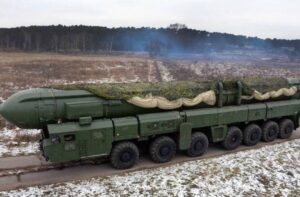
Ukraine has confirmed that the missile which hit the Lviv region overnight was moving at roughly 13,000 km/h along a ballistic trajectory, strongly suggesting the use of Russia’s Oreshnik intermediate‑range ballistic missile equipped with MIRV technology and marking only the second time an ICBM‑ or IRBM‑class weapon has been used in combat.
Military officials said radar and trajectory data showed the incoming missile traveling at hypersonic speed on a steep ballistic arc, a flight profile Ukrainian analysts say corresponds to the Oreshnik system, which can reach over 12,000 km/h and deploy multiple independently targetable reentry vehicles. While Kyiv has not issued a formal public declaration naming the missile, several defense and intelligence sources describe the Lviv strike as a likely repeat use of Oreshnik, following its first documented combat employment against the Pivdenmash facility in Dnipro in November 2024.
Security experts note that with the Dnipro attack and now the suspected Oreshnik strike near Lviv, Russia has twice resorted to deploying ICBM‑ or IRBM‑class missiles in the Ukraine war, breaking long‑standing norms against using such strategic systems in active conflict. Analysts warn that each new use of the MIRV‑capable Oreshnik not only complicates Ukraine’s air defense challenge but also signals a dangerous escalation in Russia’s willingness to field weapons traditionally associated with nuclear delivery, even when used with conventional or non‑explosive warheads.