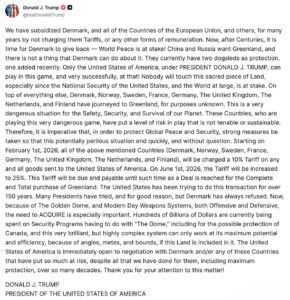
President Donald J. Trump said he will levy a 10% tariff on imports from eight European countries from February 1, with the duties rising to 25% on June 1, 2026, unless Denmark agrees to a deal for the United States to purchase Greenland, sharply escalating tensions with key NATO allies.
Trump unveiled the move in a series of posts on his Truth Social platform on Saturday, declaring that “any and all goods” from Denmark, Finland, France, Germany, the Netherlands, Norway, Sweden, and the United Kingdom will face the new tariff as part of what he called a “necessary correction” to Europe’s stance on Greenland. The president tied the policy directly to his long-standing ambition for the U.S. to acquire the Arctic territory, saying the duties would remain in place and climb to 25% on June 1 if Copenhagen does not reach an agreement to sell Greenland to Washington.
In his posts, Trump also cited recent deployments and patrols by European naval and air forces around Greenland and the broader North Atlantic, accusing the targeted countries of “trying to box out America” from a strategically vital region rich in natural resources and critical sea lanes. He argued that U.S. ownership of Greenland would strengthen NATO and Western security, while accusing European leaders of “selfish obstruction” that, he claimed, leaves the alliance more vulnerable to Russian and Chinese influence in the Arctic.
European officials reacted with alarm, warning that the planned tariffs risk sparking a major transatlantic trade clash and undermining cooperation on security, climate, and Arctic policy. Danish leaders reiterated that Greenland is not for sale and stressed that the island’s self-governing authorities have repeatedly rejected any proposal to transfer sovereignty, while officials in other affected countries vowed to coordinate a joint response with the European Union and the United Kingdom.
Economists and trade analysts noted that the threatened duties, if implemented as described, would hit a broad range of sectors, from European autos and machinery to food, pharmaceuticals, and luxury goods, and could invite retaliation against U.S. exports. The announcement also raised fresh questions about the future of the rules-based trading system and NATO cohesion, as the United States conditions economic pressure on a disputed territorial acquisition involving a longstanding ally.