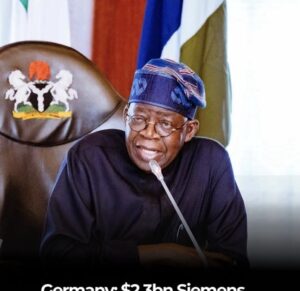
Germany has confirmed that the $2.3 billion Siemens Presidential Power Initiative, originally launched to modernise Nigeria’s transmission and distribution network, remained largely dormant under the last administration but has now regained momentum under President Bola Tinubu, with both countries framing the revived partnership as central to stabilising the national grid and expanding electricity access across Africa’s largest economy.
German diplomats say the Presidential Power Initiative, conceived as a government‑to‑government deal between Abuja and Berlin, is again moving forward after years of slow execution and uncertainty. The programme was designed to overhaul ageing transmission and distribution infrastructure, cut technical losses, and raise the volume of power that can be reliably wheeled across the national grid.
Under the original framework, Siemens set phased capacity milestones to lift Nigeria’s available power from a historically low base to several thousand additional megawatts through targeted investments in substations, transformers and grid automation. However, implementation lagged, and officials in Berlin now openly acknowledge that the project was effectively stalled for much of the previous administration, despite earlier payments and equipment deliveries.
Since taking office, President Tinubu has made the project a diplomatic and economic priority, using high‑level meetings with German Chancellor Olaf Scholz and Siemens Energy to fast‑track execution and unblock bottlenecks. Nigerian and German officials have signed updated implementation and performance agreements, enabling the supply, installation and commissioning of Siemens‑manufactured equipment aimed at modernising key parts of the grid within defined timelines.
Recent updates from both sides highlight the arrival of new transformers and substations, as well as approvals for major engineering, procurement and construction contracts under the PPI, which are expected to add significant transmission capacity once completed. German representatives say the renewed push is meant not only to stabilise Nigeria’s grid and cut outages, but also to support industrial growth, job creation and regional power‑trade ambitions.
The revitalised power partnership is unfolding as Nigeria seeks to unlock its vast gas reserves to fuel power plants and underpin broader energy security. Officials in Abuja argue that pairing a stronger transmission backbone with increased gas‑fired generation is essential to delivering more reliable electricity to households, businesses and critical public services, after years of chronic shortfalls.
German envoys, drawing on their country’s own recent experience in diversifying energy sources and building new gas import infrastructure, have signalled interest in deeper cooperation on gas supply and clean‑energy transition alongside the Siemens‑led grid upgrade. They frame the PPI as a long‑term platform for development that could help transform Nigeria into a regional power hub, provided current momentum is sustained and promised investments are fully delivered.