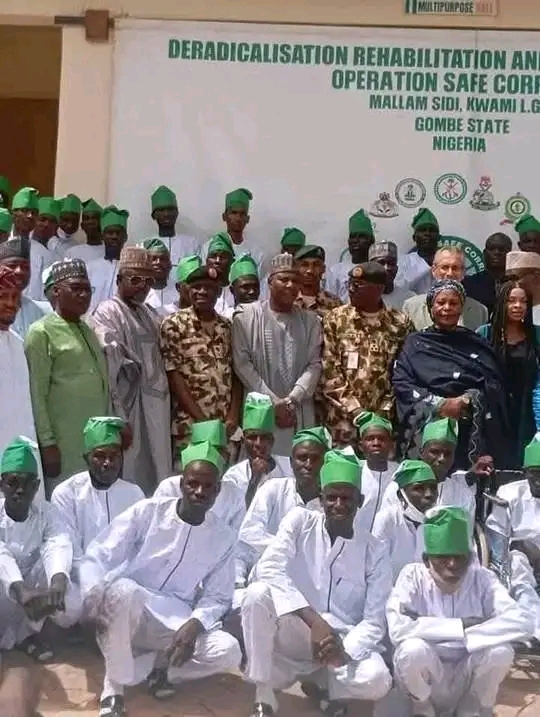
A total of 117 repentant terrorists have completed the Federal Government’s de-radicalisation and rehabilitation programme under Operation Safe Corridor (OPSC) in Borno State, and are now set for reintegration into society.
The announcement was made at a high-level stakeholders’ meeting convened by the Defence Headquarters at the Nigerian Army Resource Centre in Abuja.
Director of Defence Information, Samaila Uba, confirmed that the OPSC Coordinator, Y. Ali, disclosed the development while outlining plans for transferring the rehabilitated ex-fighters to their respective state authorities.
The former insurgents underwent the Disarmament, Rehabilitation and Reintegration (DRR) process at Mallam Sidi Camp, a facility designed to reform and reintegrate surrendered fighters.
Ali hailed the programme as a major success, pointing to improved coordination between federal and state governments in handling former combatants.
He commended the Chief of Defence Staff, Olufemi Oloyede, for strengthening institutional support for the initiative, describing OPSC as a multi-agency stabilisation programme backed by the 1999 Constitution and international humanitarian standards.
Since its launch in 2016, Operation Safe Corridor has processed thousands of surrendered fighters, refining its screening process, ideological reorientation modules and psychosocial recovery systems.
The programme has also expanded to the North-West, with a new DRR camp established last year. Zamfara State is currently working with Defence Headquarters to recalibrate the facility toward a broader reintegration and victim-healing framework. Benue State has also formally requested the establishment of a similar camp.
Representing the Chief of Defence Staff, Jamal Abdusalam described the initiative as a critical pillar of Nigeria’s security strategy.
“Since its inception in 2016, operation safe corridor has processed thousands of clients through a controlled and integrity-driven disarmament, rehabilitation and reintegration framework,” he said.
“When properly screened and coordinated, surrender pathways degrade insurgent cohesion, generate actionable intelligence and support long-term stability.”
The meeting attracted representatives from federal ministries, the Office of the National Security Adviser, neighbouring countries including Burkina Faso, Chad, Niger and Cameroon, and international partners such as Norway, the United Kingdom, the European Union, the Foreign, Commonwealth and Development Office, the International Committee of the Red Cross and the International Organisation for Migration.
With 117 more graduates now cleared for reintegration, the debate over balancing justice, security and rehabilitation is once again front and centre.