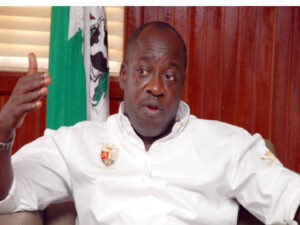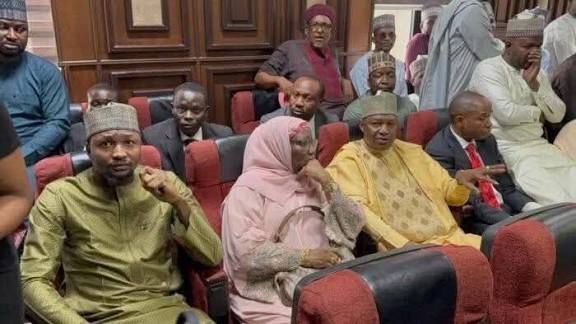
A Federal High Court sitting in Abuja on Friday granted bail to former Attorney-General of the Federation (AGF), Abubakar Malami; his wife, Asabe Bashir; and their son, Abdulaziz Malami, in an alleged N8.1 billion money laundering case brought against them by the Economic and Financial Crimes Commission (EFCC).
The presiding judge, Joyce Abdulmalik, admitted the three defendants to bail in the sum of N200 million each, with two sureties in like sum.
As part of the bail conditions, the court ruled that one of the sureties must deposit title documents of a property located in either Maitama or Asokoro in Abuja.
The court also directed the defendants to submit their international passports.
Pending the fulfilment of the bail conditions, the defendants are to remain in the custody of the Nigerian Correctional Service (NCoS).
The trio were re-arraigned before Justice Abdulmalik following the reassignment of the case.
In the 16-count charge filed by the EFCC, the anti-graft agency alleged that the former AGF, his wife, and their son conspired to launder proceeds of unlawful activities between 2015 and 2025.
According to the commission, the defendants allegedly used several bank accounts and corporate entities to conceal the origin and ownership of funds amounting to over N8.1 billion.
The EFCC further alleged that large sums of money were routed through companies linked to the Malami family, including Metropolitan Auto Tech Limited and Meethaq Hotels Limited, with transactions carried out through multiple commercial banks.
Investigators claim the funds were deliberately structured in a way designed to disguise their alleged illicit origin and evade regulatory scrutiny.
Court documents also revealed that part of the money was retained as cash collateral for bank facilities, including about N600 million, which the commission said the defendants knew or ought reasonably to have known were proceeds of unlawful activity.
The anti-graft agency also accused the defendants of using the funds to acquire high-value properties in Abuja, Kano and Kebbi states.
The properties, according to the EFCC, include both residential and commercial assets allegedly purchased directly or through proxies in an attempt to conceal the true ownership.
The commission further alleged that the defendants worked together to indirectly acquire assets, maintain control of the alleged illicit funds, and disguise the true source of the money through a web of financial transactions and corporate fronts.
The case has been adjourned for further proceedings.