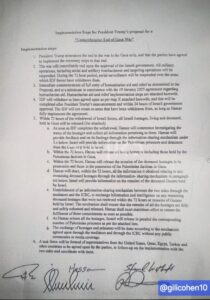
A breakthrough ceasefire deal for the Gaza Strip was signed yesterday by mediators from the United States, Israel, Egypt, Qatar, Turkey, and Hamas, setting in motion a series of coordinated steps to end the two-year-long war, release captives, and bring critical relief to civilians.
After days of intensive negotiations in Sharm el-Sheikh, representatives from Israel, Hamas, and international mediators finalized the first phase of a comprehensive plan to halt the conflict. The agreement stipulates an immediate end to fighting, with a ceasefire to come into effect within 24 hours of Israeli cabinet approval. Israeli forces will begin a withdrawal to specified “Yellow Line” positions inside Gaza, ceding full control of western areas as one of the first confidence-building measures.
A 72-hour window is then triggered, during which all Israeli captives held in Gaza including those believed to be still alive will be released. For each Israeli hostage, Israel will release a large number of Palestinian prisoners; the current agreement reportedly includes around 250 prisoners sentenced to life and 1,700 other detainees from Gaza, as well as all women and children. Remains of deceased hostages and prisoners are included in the exchanges, supervised internationally.
Humanitarian relief is another key principle: hundreds of trucks loaded with food, medicine, and supplies are set to enter Gaza immediately, addressing a dire humanitarian crisis. The United States’ 20-point peace plan, on which the deal is based, requires a ramping up to as many as 600 truck convoys daily as conditions permit.
The agreement is set to unfold in three stages, with Phase One focused on ceasing hostilities and hostage exchanges, and subsequent phases tied to a more permanent ceasefire, further prisoner releases, Israeli withdrawal, and the reconstruction of Gaza. Implementation will be monitored by Egypt, Qatar, Turkey, the United States, and international agencies.