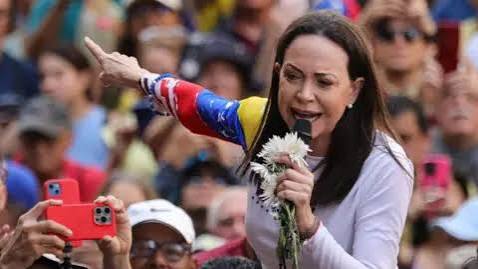
Venezuelan opposition leader María Corina Machado, who has been in hiding for months, has told the BBC that she knows “exactly the risks” she’s taking by travelling to Norway to collect her Nobel Peace Prize.
Machado appeared in Oslo in the middle of the night, waving from the balcony of a hotel. It was the first time she has been seen in public since January.
The 58-year-old made the covert journey despite a travel ban and a threat from the Venezuelan government that she would be labelled as a fugitive.
In an emotional moment, Machado waved to cheering supporters who had gathered outside the Norwegian capital’s Grand Hotel, blowing them kisses and singing with them.
To their delight, she then came outside and greeted them in person, climbing over the security barricades to get closer.
“Maria!” “Maria!” they shouted, holding their phones aloft to record the historic moment.
Earlier on Wednesday, her daughter, Ana Corina Sosa, accepted the Nobel Peace Prize on her mother’s behalf.
The Nobel Institute awarded Machado the prize this year for “her struggle to achieve a just and peaceful transition from dictatorship to democracy” in Venezuela.
Until Wednesday night, the mother of three had not seen her children in about two years, having sent them away from Venezuela for their own safety.
In an interview with the BBC’s Lucy Hockings after her balcony appearance, Machado said she had missed their graduations, and the weddings of her daughter and one of her sons.
“For over 16 months I haven’t been able to hug or touch anyone,” she said. “Suddenly in the matter of a few hours I’ve been able to see the people I love the most, and touch them and cry and pray together.”
During the BBC interview, Machado had many rosary beads hanging around her neck, which she said supporters had given to her outside the hotel.
There has been much speculation about whether she will be able to safely return to Venezuela.
“Of course I’m going back,” she told the BBC. “I know exactly the risks I’m taking.”
“I’m going to be in the place where I’m most useful for our cause,” she continued. “Until a short time ago, the place I thought I had to be was Venezuela, the place I believe I have to be today, on behalf of our cause, is Oslo.”