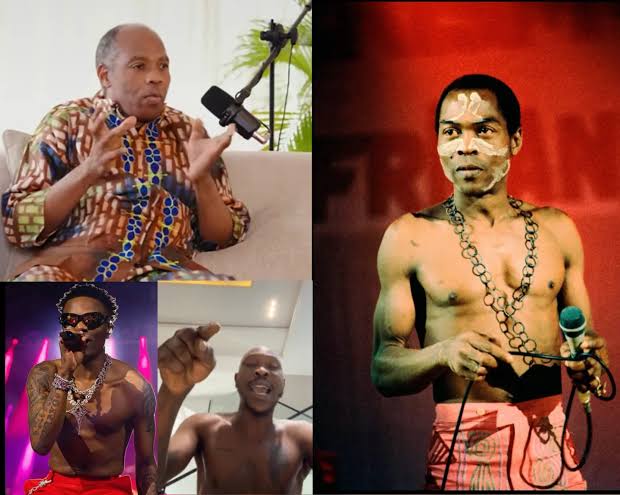
Grammy-nominated Afrobeat icon, Femi Kuti, has broken his silence on the raging social media battle comparing his late father, Fela Anikulapo-Kuti, with afrobeats superstar Wizkid, describing the debate as needless, distracting and unfortunate.
Speaking during an interview on Arise Television on Friday, Femi made it clear he intentionally stayed away from the controversy, stressing that Nigeria has far bigger problems than celebrity comparisons.
The comments come after days of heated online arguments over Fela’s legacy and whether modern afrobeats stars should be likened to the legendary musician.
The debate has dominated timelines, drawing reactions from musicians, fans and cultural commentators.
The controversy gained momentum after Fela’s youngest son, Seun Kuti, openly criticised attempts by Wizkid’s fan base, popularly known as “FC”, to brand the singer as the “new Fela.”
During a live Instagram session, Seun accused the fans of constantly dragging his father’s name into online music debates.
Seun argued that comparing Wizkid to Fela undermined the cultural, musical and political legacy Fela built over decades, insisting that his father’s name should not be reduced to a reference point in contemporary music arguments.
The exchange later spiralled into personal attacks, with Seun also addressing disputes surrounding his long-standing nickname, Big Bird, while accusing Wizkid’s camp of fuelling the controversy instead of calming tensions. He maintained that his criticism was aimed at fan culture, not Wizkid personally.
After days of back-and-forth, Wizkid reacted by posting a video of a woman criticising Seun’s conduct before making direct and insulting posts targeted at him on Instagram. Seun responded by pointing to corporate tributes to Fela, noting that millions of naira had been spent to honour his father’s legacy.
Reacting to the drama, Femi Kuti said the comparisons involving Fela should never have happened.
“Fela is our father, and I would say all the younger artists respect him. I don’t think it’s an issue that should have been brought up because he’s the template of many things musically and artistically in Nigeria,” he said.
He added, “Fela should just be put in a section of his own, and we just idolise and respect him.”
Femi refused to take sides, citing his close relationship with both parties.
“I don’t want to go into Seun and Wizkid’s matter because Seun is my brother and Wizkid is like a son. I just wish it did not arise. Hopefully, everybody will calm down very soon.”
He urged Nigerians, especially young people, to channel their energy into nation-building instead of divisive online fights.
“Nigeria has been participating in the Grammys so much these days. It’s good for Africa and the country; it’s good we’re getting the recognition we deserve. So, we should just be happy for ourselves and use this to build the music industry and the country. Tribalism and terrorism are big issues in the country today; those are the things young people and I should be focused on today.”
Femi is not alone in calling for calm. Earlier, Fela’s daughter, Yeni Kuti, also warned against public feuds involving cultural icons, saying such clashes damage Nigeria’s image.
Speaking on TVC’s Your View, she said, “When two giants fight, it’s the ground that suffers. In this situation, it’s Nigeria’s reputation that is suffering because we are now seen as a people that do not respect our icons. Whichever way you look at it, he started a genre of music. He’s an icon, so if you have a problem, why are you attacking him? He has done his own, and he has gone. He has been dead 27 years, and we are still mentioning his name; that is the answer to his greatness. Let us respect that.”
“I refused to respond to some of the insults that they have been hurling, and I love Wizkid a lot. He’s my small friend, and we have come a long way together. I remember when he was a backup singer at the shrine during Felabration.”
The debate comes as Fela Anikulapo-Kuti is set to receive a Grammy Lifetime Achievement Award posthumously, becoming the first African artist to earn the honour.
Reacting to the recognition, Femi described the moment as deeply emotional, especially for those who witnessed Fela’s battles with Nigeria’s military regimes.
“Everybody is very happy. We’re excited. I’m in Los Angeles right now, and it’s very hard to really explain, unless you were alive in the 1970s, what my father did, fighting dictatorship in Nigeria at that time. People were very frightened of the military.”
“My elder sister, my brother Seun, my son Made, and the rest of the family have all done our little bit to keep talking about him. You have musicians playing his music. You have people studying his music. You have Afrobeat artists today inspired by him. People are sampling his music.”
He added, “To top it with one of the biggest awards in the world, the Grammys, what more can we want? But it’s not for the family alone. Fela was a father to many people. That’s why we say ‘our father’. He was a voice for the voiceless in the 1970s and 1980s.”
Reflecting on Nigeria’s lingering challenges, Femi noted that many of the issues his father protested against decades ago remain unresolved.
“Africa—Nigeria—should be the envy of the world. It’s shameful that we are still struggling with basic infrastructure. What is so hard about making Nigeria great?”