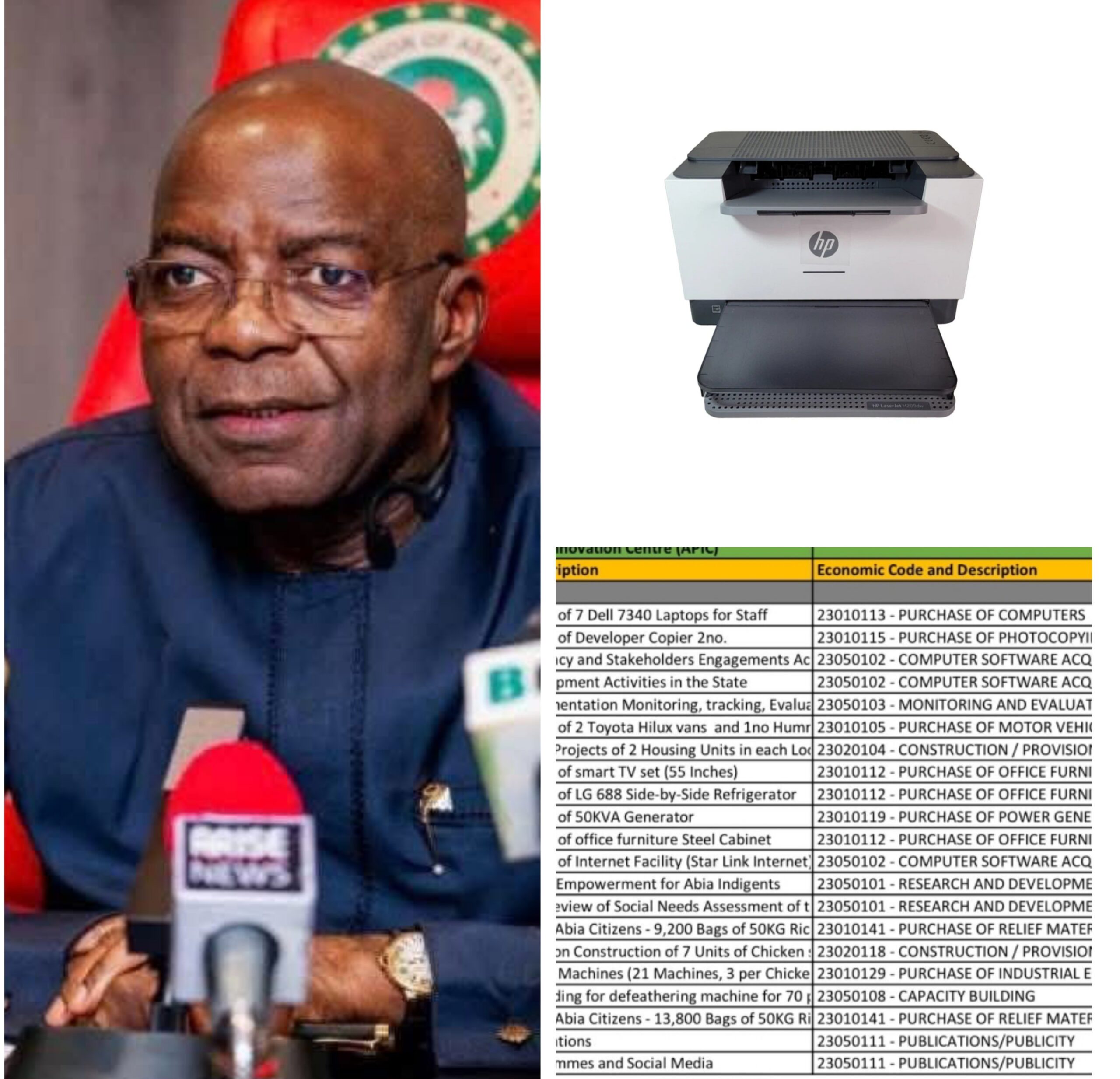
Abia State’s 2026 budget has triggered outrage after it emerged that the Alex Otti-led government plans to spend a staggering N210 million on the purchase of a single photocopier for its Lagos Liaison Office, MUK TV has gathered.
Accordig to SaharaReporters, a review of the approved budget shows that N210,831,142.00 was allocated for the photocopier under Total Capital Expenditure, Reform for Government and Governance, Abia State Liaison Office, Lagos.
Governor Alex Otti assented to the N1,016,228,072,651.99 2026 Appropriation Bill in December 2025.
The eye-popping figure becomes even more controversial when placed side by side with the 2025 budget, where only N2.5 million was provided for the purchase of the same item.
The budget document offered no explanation for the over N208 million increase.
The spending revelation did not stop there, with further checks showing that N287 million was also earmarked under the Abia Policy Innovation Centre for publicity on social media and radio.
The allocation adds to the increasing list of controversial expenditures under the Otti administration.
In 2023, the newspaper had reported that the government spent a whopping N927 million in just three months on refreshments/meals, honorarium, allowances, and welfare packages for officials.
Within the same period, another N737,922,661.25 was spent on vehicles, with the budget performance report failing to disclose how many vehicles were purchased or who benefited from them.
According to documents published on the state website, between July and September 2023 alone, N223,389,889.84 went into refreshments and meals, while N305,400,000.00 was spent on honorarium and sitting allowances.
The government also claimed it spent N397,520,734.00 on welfare packages during the same period.
The report further shows that N362,804,050.00 was used to buy trucks, N400,890,000.00 for buses, and N252.4 million to run the Deputy Governor’s office for just three months.
Meanwhile, only N25 million was spent on the repair of public schools across the state, despite the visibly poor condition of many schools.
Across Abia’s 17 local government areas, public primary and secondary schools are reportedly in a state of decay, with leaking roofs, broken desks, damaged doors and windows, sharply exposing the contrasts with the government’s lavish spending priorities.