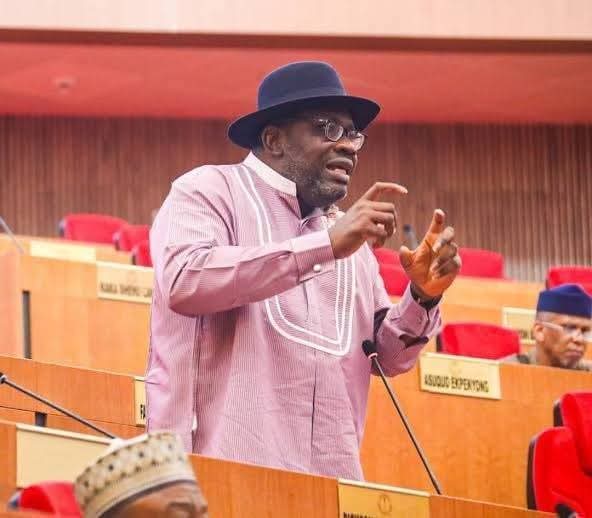
Bayelsa West Senator, Seriake Dickson, has fired back at critics of the Electoral Act Amendment Bill, insisting that removing the words “real time” does not weaken electronic transmission of results or threaten Nigeria’s democracy.
Speaking on ARISE News Tuesday, the ranking member of the Senate Committee on Electoral Matters declared that the Senate’s latest move is not a setback.
“I don’t count the proceedings of today and the outcome as a loss for democracy,” he said.
The Senate had reviewed Clause 60(3) of the bill after public outrage, restoring electronic transmission of results to INEC’s Result Viewing Portal (IREV) but retaining a proviso allowing manual collation in cases of network failure.
Many Nigerians argued that dropping the explicit “real-time” requirement could open the door for manipulation. But Dickson disagreed, saying the real victory was making electronic transmission compulsory.
“I’m not here as spokesman of the Senate. I’m here to give my views as someone who has been deeply involved in all these processes as a ranking member of this committee and as someone who participated in the proceedings of today,” he said.
According to him, debates on electronic transmission did not start yesterday.
“This has been going on for about two years or so — different workshops, conferences at the Senate Committee, joint committees and also interactions with INEC,” he said.
Dickson revealed he was absent when the Senate initially rejected compulsory electronic transmission due to a personal loss.
“I was not there when the Senate took that decision earlier, about a week ago, as I was bereaved… Today was the very first day I went to sit in the Senate because of the importance of this matter,” he said.
He described the earlier rejection as “unfortunate,” especially after INEC had assured lawmakers of its readiness.
On the controversy surrounding “real time,” Dickson argued that the phrase was being overstretched.
“What is the meaning of real time? We are not voting electronically in Nigeria,” he said, adding that “the word ‘real time’ in this context is actually superfluous. It doesn’t on its own give you a transparent election.”
For him, the real safeguard lies at the polling unit level.
“The primary evidence of who won an election is the EC8A… INEC compels presiding officers to transmit the result to IREV. That is good enough for us,” he said.
Though he admitted he was not comfortable with the network-failure proviso, he said compromise is part of lawmaking.
“I don’t agree with the proviso that has been included, but parliament works on the basis of majority,” he said.
Dickson stressed that the law still makes electronic transmission the default rule.
“The general rule is that every presiding officer shall transmit the result electronically. That is mandatory.”
He ended on a note of gradual reform, insisting progress does not come overnight.
“You make gains incrementally… We have made electronic transfer mandatory, and that is progress,” he said.