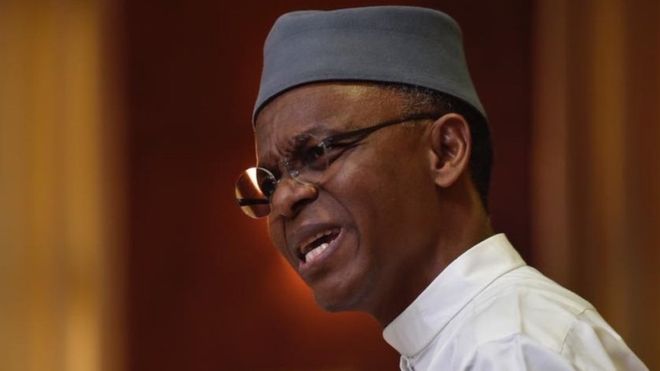
Former Kaduna Governor Nasir el-Rufai has given an insight into the drama that played out at the Nnamdi Azikiwe International Airport, Abuja on Thursday, alleging a failed plot to arrest and abduct him upon his return from Cairo, Egypt.
El-Rufai accused the Independent Corrupt Practices and Other Related Offences Commission (ICPC) of using operatives of the Department of State Services (DSS) to carry out the move. According to him, nearly 50 security personnel were positioned at the airport over his arrival.
In a BBC interview published Friday, the former governor detailed the tense encounter after landing in Abuja.
“We walked towards the immigration counter and they (DSS operatives) said I should give them my passport for them to go and do…. I said, ‘no, I always do my immigration biometrics’. I went there, did that and walked out,” he said.
“Two more senior people came and said they are from the DSS and they wanted me to go to their office. I didn’t know whether they have an office at the airport or they meant the headquarters.
“All I asked for is a courtesy of a letter of invitation. That is what I believe I am entitled to as a Nigerian. They did not have a letter.
“Subsequently, we learnt that it was ICPC that procured the DSS to do the abduction. I was supposed to be abducted by the DSS and taken to ICPC.”
Responding to critics who questioned why he appeared alarmed, el-Rufai fired back.
“I’m afraid of tyranny, undemocratic practices and people that don’t understand that in a democracy, the executive is not all-in-all,” the former governor said.
“There is a legislature that should be allowed to function, which has not been allowed to function. There is a judiciary that is supposed to be independent, which is being procured and weaponised against the opposition.”
Before the airport standoff, el-Rufai had hinted that a politically motivated arrest could be waiting for him upon his return.
Meanwhile, two of his associates — Jimi Lawal and Amadu Sule — are currently facing fraud and money laundering charges filed by the ICPC.