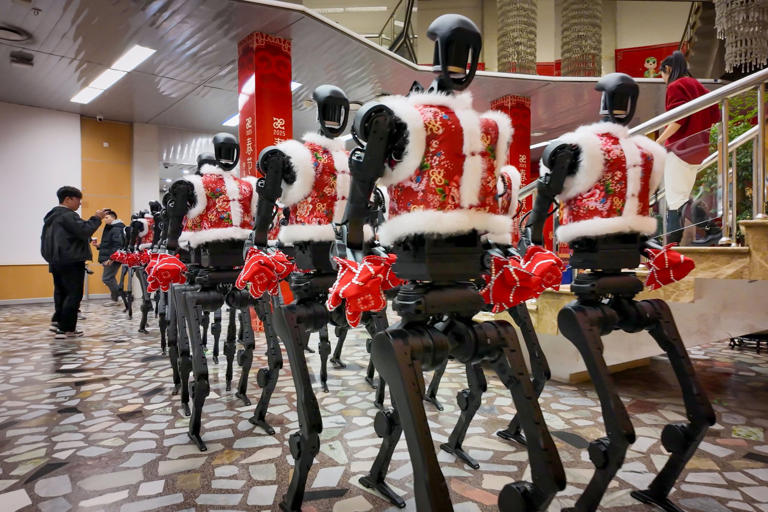
People across China and several countries in Asia, Europe and South America marked the Lunar New Year on Tuesday with prayers, fairs, fireworks and Robots to welcome the Year of the Horse and the start of a new cycle in the Chinese zodiac, as crowds gathered at temples to burn incense and pray for health and success, this Lunar New Year is the most important annual holiday in China and is observed in other East Asian countries and by communities abroad.
meanwhile Chinese tech companies are competing to make their mark during the Spring Festival Gala presented by state-run broadcaster CCTV, a variety show and annual spectacle that provides a rare nationwide marketing opportunity, and is also an unmistakable signal of political alignment with Beijing’s industrial priorities.
On Monday night, the annual Spring Festival gala aired by China Central Television featured humanoid robots as part of its programme.
In one segment, children performed martial arts alongside robots from Unitree Robotics, which demonstrated movement sequences and handled swords.
The display reflected China’s efforts to expand robotics powered by artificial intelligence. Some viewers praised the performance, saying it offered inspiration for young people. Others felt it changed the tone of the show.
This year, ByteDance’s cloud computing arm, Volcano Engine, secured an “exclusive AI cloud partnership” with the gala, scheduled for Monday, taking the baton from last year’s sponsor Alibaba Cloud, the cloud computing and artificial intelligence unit of Alibaba Group Holding. This comes as demand for computing power surges, and China’s major cloud-service providers are locked in an increasingly fierce rivalry.
ByteDance, the parent of Douyin and TikTok, is using the occasion to showcase its full-stack AI capabilities. In the run-up to the holiday, the company unveiled Seedance 2.0, a video-generation model that drew widespread attention globally, and on Saturday it released updated Doubao-Seed 2.0 series models.
In a promotion for its consumer-facing Doubao app, the company plans to distribute more than 100,000 tech products, including drones, electric vehicles, robots and 3D printers, along with digital red envelopes worth up to 8,888 yuan (US$1,286) through lucky draws this year.
The gesture faces off against Tencent’s Yuanbao and Alibaba’s Qwen AI apps, which before the holiday rolled out giveaways worth 1 billion yuan and 3 billion yuan, respectively, in cash and vouchers, as the ancient tradition of lucky money found a new battleground in the AI era.
Excluded by the CCTV-ByteDance partnership, Alibaba sought other avenues for Qwen, sponsoring galas organised by local broadcasters in Shanghai, Zhejiang, Jiangsu and Henan. Alibaba owns the South China Morning Post.
Humanoid robots are expected, once again, to entertain audiences after a Yangge folk dance performed by Unitree robots on last year’s stage went viral.
Hangzhou-based Unitree, Wuxi-based Magiclab, Beijing-based Galbot and Noetix have all announced partnerships with the gala, albeit under slightly different titles, in deals said to be valued at around 100 million yuan. The specific performance formats remain undisclosed.
CCTV teamed up this year with RedNote, Bilibili, Kuaishou and Douyin to expand digital distribution and drive engagement, even though the show often becomes the subject of online roasting.
Other companies have also sought visibility. Dreame Technology, a Suzhou-based maker of smart home appliances, secured a commercial slot on the gala as part of an aggressive, high-profile marketing push that also included advertising during the Super Bowl in the United States.
Budget retailer Miniso and trading-card maker Kayou are among the sponsors as well, both rolling out Year of the Horse-themed merchandise tied to the festivities.
More Articles from SCMP