Archaeologists in Israel have unearthed a rare 1,400-year-old marble artifact near the Sea of Galilee, offering fresh insight into how early Christians carried out baptism rites at a site long associated with the ministry of Jesus. The discovery was made in the ruins of the Byzantine-era city of Hippos, which overlooked the Sea of Galilee and served as an important Christian center and bishop’s seat in late antiquity.
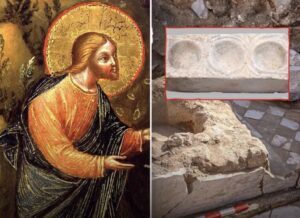
The marble block was found inside a church complex, in a special baptismal hall known as a photisterion, adjacent to a large baptismal font. Carved with three identical hemispheric depressions on its upper surface, the object has “no known parallel” in the archaeological record, according to researchers from the University of Haifa.
Based on its location and design, the team believes the block was used during baptism ceremonies to hold three different sacred oils applied at various stages of the rite. Early Christian texts refer to multiple anointings with distinct oils, but experts say physical evidence of such a three-part practice has been elusive until now.
The church and its baptismal hall are thought to have been renovated around 590 CE and later destroyed in a major earthquake in 749 CE, which buried the marble block under rubble and preserved it in situ for more than a millennium. Archaeologists say the artifact was still positioned between the main font and other liturgical fittings when it was uncovered, strengthening the case for a ritual function tied directly to baptism.
Hippos lies above the Sea of Galilee, a landscape closely linked in Christian tradition to Jesus’ preaching, miracles and the calling of his disciples. For many believers, the find highlights how later generations of Christians continued to initiate new members of the faith in the same hills overlooking waters where the Gospels situate key episodes of Jesus’ ministry.
Scholars caution that research is ongoing and alternative interpretations have been proposed, including the possibility that the block functioned as a receptacle for offerings rather than oils. Further study of the find and comparisons with other early church sites are expected to determine whether the marble block indeed preserves evidence of a previously unknown stage in the ancient Christian baptismal rite.