An Abia-born Scotland-based public commentator and financial analyst, Eke O Ako (also known as Ek Steve), has raised serious concerns over the administration of Governor Alex Otti, questioning the transparency, cost efficiency, and verifiable impact of projects executed since he assumed office.
In an open letter, Ako commended the recent publication of government “achievements” by the Chief Press Secretary, Ukoha Njoku Ukoha, describing it as “growth” in communication.
However, he argued that the disclosures fall short of genuine accountability.
“Rather than provide clarity, it has raised even deeper concerns,” he stated, adding that what was presented amounted to “vague enumeration without substance.”
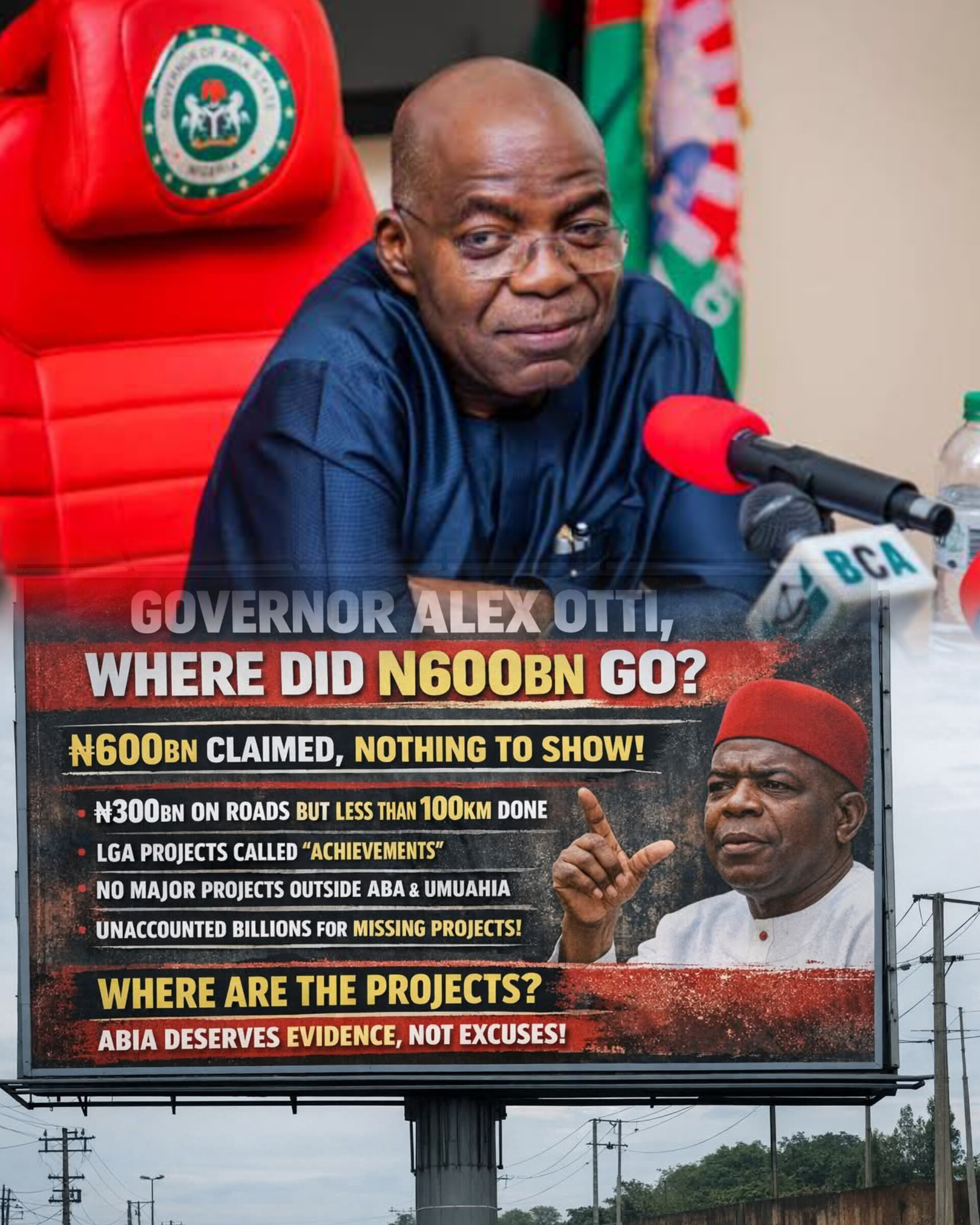
He questioned the government’s claim of about ₦600bn spent on capital expenditure, insisting that on-ground projects do not reflect commensurate value.
“You claimed about ₦600bn for capital expenditure from when you assumed office to 31st December 2025, yet the totality of projects on ground does not reasonably reflect even ₦200bn in verifiable delivery,” he said.
Ako further argued that many of the road projects being executed are largely resurfacing works rather than new constructions. He also queried the absence of identifiable projects across the state despite reported expenditure of several billions of naira.
“What is the status of the projects that cannot be identified across the state for which your government has paid several billions of Naira of public funds, some right from 2023?” he asked.
He added that “most of the road projects are merely asphalt overlay of existing roads which were almost in perfectly good condition,” and maintained that “you have no major road construction project in the state today.”
The commentator also criticized the scale and distribution of projects, noting that many listed initiatives appear to be local government-level interventions.
“Most of the projects listed are LGA-level interventions (Trunk C Roads), and it is frankly embarrassing to see items such as ‘covering of manholes’ presented as state achievements,” he said.
Ako alleged that several parts of the state, particularly outside Aba and Umuahia, have seen little or no meaningful development, claiming that “Ngwa LGAs and several other regions outside Aba and Umuahia are yet to witness one significant, impactful project.”
He also raised concerns over transparency mechanisms, arguing that the administration has not maintained a functional public procurement system.
“Your administration has reportedly spent over ₦6 billion on ICT, yet you have no functional, transparent, and continuously updated public portal detailing projects, scope, contractors, and costs,” he stated.
According to him, the absence of a transparent procurement platform contrasts with previous systems, referencing a public portal that reportedly existed under the previous administration.
On cost efficiency, Ako questioned the justification for road project expenditures, alleging that rehabilitation of Trunk B roads in Abia costs significantly more than comparable projects elsewhere.
“Rehabilitation of Trunk B roads in Abia reportedly exceeds ₦6 billion per kilometre,” he claimed, comparing it with federal projects executed at lower per-kilometre costs.
He further asked, “Why is Abia paying premium prices for sub-scale or unclear outputs?” and “Who benefits from this pricing structure?”
Beyond infrastructure and finance, Ako argued that governance outcomes have not translated into improved living conditions for residents.
“The living standards of Abians have not improved,” he said, adding that “rural communities… remain largely neglected.”
He also criticized what he described as a lack of visible legacy projects despite significant public expenditure.
“Where are your legacy projects to justify earnings of about N1.6trn?” he asked, stressing that governance should be measured by “verifiable delivery, measurable outcomes, and visible impact.”
The open letter concluded with a strong call for transparency and accountability, urging the state government to provide concrete evidence of project execution and financial stewardship.
“Abians are not asking for narratives. We are asking for evidence,” he stated, maintaining that the government’s claims must be backed by verifiable data and clear project documentation.
The remarks add to ongoing public debate over fiscal transparency, project implementation, and accountability in Abia State, as stakeholders continue to demand clearer disclosure of how public funds are being utilized.