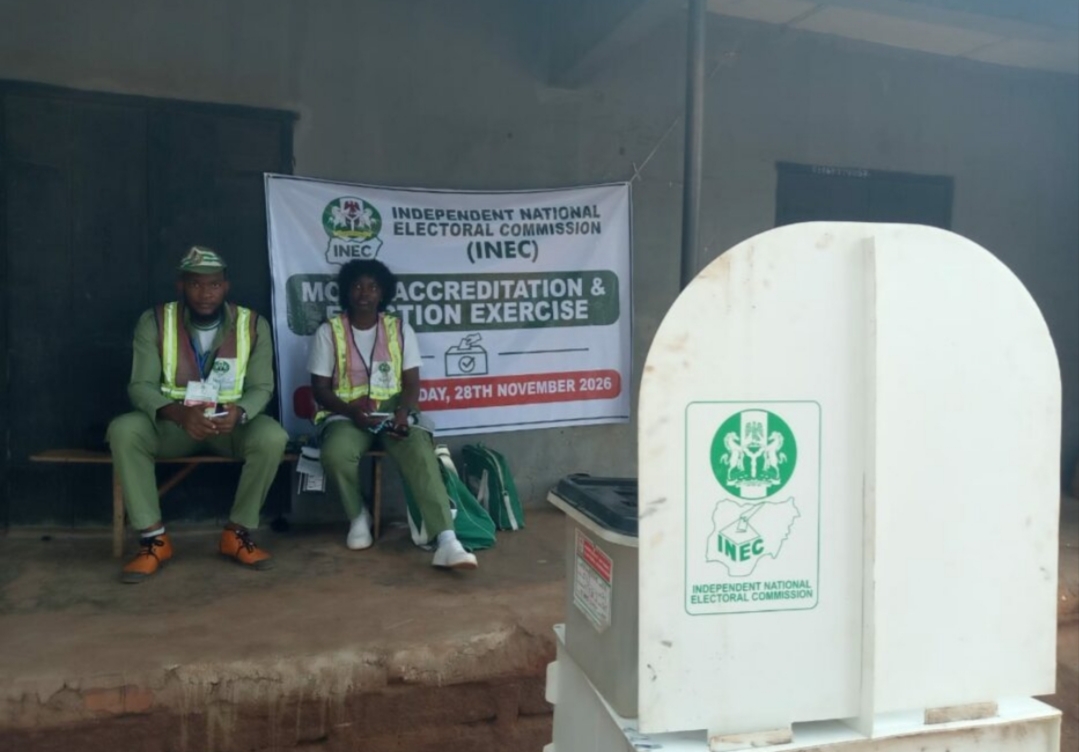
The Independent National Electoral Commission (INEC) mock accreditation exercise in Anambra State recorded no reported technical challenges with the Bimodal Voter Accreditation System (BVAS) or result uploads in the polling units monitored on Saturday, November 28, 2026.
However, voter participation was considerably low across the locations visited during the exercise, which was conducted as part of preparations for the 2027 general elections.
Observations from Awka South and Awka North Local Government Areas showed that the accreditation equipment and result transmission process operated without reported disruptions.
In Awka South, the exercise proceeded smoothly at polling units 008 and 009 in Nkwo-Amaenyi, as well as polling units 001 and 002 in Agu-Oka, Awka Ward 1.
Similar observations were recorded at polling units 001 and 002 in Amaezike, Mgbakwu, in Awka North Local Government Area.
INEC had planned the mock exercise for two polling units in each of the 326 wards across Anambra State to assess the performance of its accreditation technology ahead of the 2027 elections.
Despite the smooth operation of the equipment, participation was limited in the monitored locations.
By the close of the exercise at 2 p.m. in Awka South, only three voters had been accredited and participated at the two polling centres monitored. In Amaezike, Mgbakwu, just one voter had been accredited as of 1 p.m.
Some residents who visited designated polling units were also unable to participate because they were not registered at those locations. Observations indicated that some of them had not received adequate information about the mock exercise.
A presiding officer at Nkwo-Amaenyi, Otuide Melvin, confirmed that the BVAS equipment functioned properly and that network challenges did not affect the uploading of results.
He, however, expressed concern over the low turnout, noting that only three voters participated in the exercise at the polling units under his supervision.
The exercise provided INEC with an opportunity to assess the performance of its election technology, while the low participation in the monitored locations highlighted the need for improved public awareness ahead of the 2027 general elections.
Written by Enitan Mudashiru