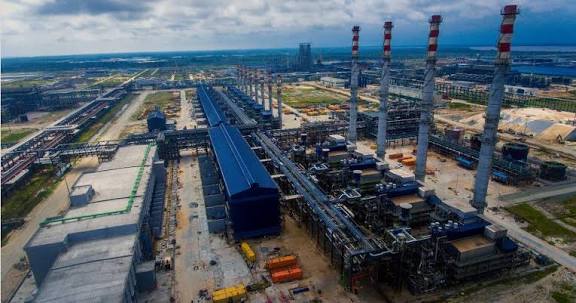
The Chief Executive of the Nigerian Midstream and Downstream Petroleum Regulatory Authority, Farouk Ahmed, has disclosed that the 650,000-barrel-per-day Dangote refinery has begun to transform Nigeria’s petroleum supply landscape, contributing an average of 20 million litres of fuel daily into the domestic market.
Ahmed stated this in Lagos on Thursday while delivering his address at the Association of Energy Correspondents of Nigeria Annual Conference, where he outlined key interventions by the Authority to strengthen the country’s energy security, boost investment, and stabilise petroleum supply.
According to him, the operation of the refinery marks a major milestone in Nigeria’s journey towards domestic refining sufficiency and energy independence.
“Without a shadow of a doubt, the operation of the 650,000-barrel-per-day Dangote refinery has changed the supply dynamics, with an average daily contribution of up to 20 million litres, undoubtedly, with potential for a future ramp-up,” Ahmed said.
He stated that the company is ramping up production to give Nigerians sufficient local supply for their fuel consumption, which he puts at an average of 50 million litres per day.
The Dangote refinery had repeatedly boasted that it could meet local petrol needs and export to other countries.
The refinery had exported over 1 billion litres of petrol to the United States and other countries of the world between June and September.
Speaking further, Ahmed said the NMDPRA viewed the development as evidence of Nigeria’s evolving refining landscape and a strong indication that the country was capable of sustaining its fuel needs locally.
Represented by the NMDPRA spokesperson, George Ene-Ita, Ahmed stressed that no one can talk about the energy future without tackling challenges of petroleum products infrastructure, supply and distribution, noting that the regulator was taking deliberate steps to consolidate recent gains in the sector.
The NMDPRA boss stressed that while the Dangote refinery had brought relief to the market, the government must still ensure product availability and resilience against external shocks with what he called the National Strategic Stock.
As a country, Nigeria is in urgent need of a diversified investment approach in our energy mix to further drive an expansion in the economy beyond the traditional focus on fossils,” he said.
“A constructive approach to developing our other energy sources would have the potential to enable sustained growth in our economy, create jobs, and expand the country’s revenue base,” Ahmed added.
The NMDPRA chief projected that, with sustained reforms and collaboration, Nigeria could evolve into an energy hub for Africa, backed by strong refining capacity, strategic storage, and regulatory certainty.
“If we get this right, Nigeria becomes not just a fossil-fuel exporter but an energy architect for Africa’s future,” he said.
Ahmed concluded by urging the media to spotlight not just the sector’s challenges but also the progress being made in refining and distribution.
“When you tell the Nigerian story of energy, don’t just report outages. Show the pipeline being welded, the cylinder being filled, the microgrid unit being installed, and the ledger showing less flaring,” he told journalists.
He reaffirmed that the authority would continue to judge its success by the real-life impact of its policies.