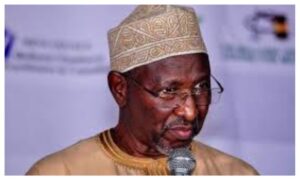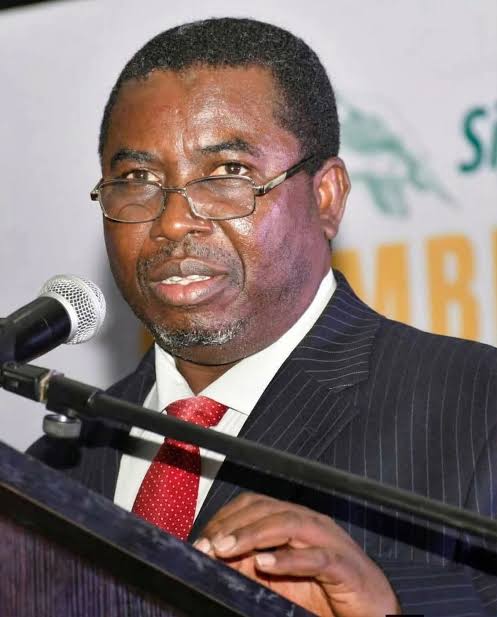
Six months after his appointment as the chairman of the Independent National Electoral Commission (INEC), Professor Joash Amupitan appears determined to beat the record of Professor Maurice Iwu as the most mistrusted electoral administrator yet.
Iwu, a professor of pharmacognosy (the study of medicinal plants), also had the distinction of managing Nigeria’s worst elections in 2007. On top of that, he gave science a bad name with the dubious claim that he had discovered the cure for Ebola.
The last thing Amupitan wants is to upstage Iwu’s sordid reputation. His comments on social media are stalking him, and he must be wondering if his job is over even before it started.
The long arm of social media
Advertisement
His archived post before his appointment shows partisan leanings during the 2023 election cycle, with content supportive of the ruling All Progressives Congress (APC), and critical of opposition figures.
The account’s activity, coupled with the sudden renaming and restriction after scrutiny intensified, has fuelled suspicion of a hurried clean-up. You’re left to wonder why, if, as he claims, he has nothing to hide.
His numerous travails since becoming INEC chair remind me of a line from Things Fall Apart, one of the greatest novels out of Africa. In it, Chinua Achebe, a master storyteller, embeds an anecdote about suffering in Okonkwo’s troubled life to deepen the impact of the moment: “When trouble knocks at your door, and you tell him to go away because there is no seat for him, he tells you not to worry because he has brought his own stool.”
Amupitan’s self-inflicted troubles already have their own stool and footrest. He’s caught in a mesh, and trying to remove one sticky web only adds to the tangled mess.
Trouble dey sleep
The first gust of the storm blew in October 2025, when the US declared Nigeria a Country of Particular Concern (CPC) over purported genocide against Christians. Almost immediately, Amupitan’s 2020 legal brief entitled “Nigeria’s Silent Slaughter”/“Legal Brief: Genocide in Nigeria – The Implications for the International Community”, in which he argued that attacks by Boko Haram and Fulani herdsmen constituted a genocide against Christians and minority groups in Nigeria, exploded in the public space.
A broad sweep of individuals and groups felt energised by the obvious religious bias verging on hate and incitement, and called on either President Tinubu to rescind the nomination, or for the National Assembly to decline confirmation, neither of which was heeded.
His 80-page chapter, entitled “Legal Brief: Genocide in Nigeria”, alleged an “Islamisation agenda” describing over 60,000 brutal killings since 2001, linking violence to a Fulani-led jihad dating back to Uthman Dan Fodio in 1804. He cited the 2015 Open Doors Report, which reported the destruction or closure of over 13,000 churches and accused the government of complicity through silence and failure to protect victims. The brief recommended a UN referral to the International Court of Justice or, as a last resort, foreign military intervention.
Fondly remembered
Following his appointment, the brief resurfaced and sparked a backlash, especially for its anti-Muslim slant. Five years down the road, his call to a national assignment blew the lid so fortuitously that it fit into the narrative of American congressmen Ted Cruz and Mike Arnold, alongside other subterranean calculations of the Trump administration, like a well-timed pass.
Amupitan’s brief understated the complexities of the security challenges in Nigeria, quite conveniently sidestepping the reality that the victims of insurgents, bandits and other crimes are indiscriminate, cutting across different religious divides.
There are inferences that this contentious report was targeted at undermining the government of late President Muhammadu Buhari, on whom a section of the population had tagged the label of religious extremism. Not thinking forward, Amupitan couldn’t have fancied that his work would boomerang on Buhari’s successor at the very nick of the author’s call to the national stage.
Not giving up
Despite public reproach, the senate went on to confirm Amupitan as INEC boss. The ‘Christian genocide’ storm more or less passed overhead and subsided without any serious damage. Always quick to retreat to their for-and-against camps, Nigerians also quietly moved on, waiting for the next controversy.
It came soon again from the Court of Appeal in Abuja. And willy-nilly, INEC was connected to the ruling, having been joined as a party in the case. It was the judgment against the African Democratic Congress (ADC) that invalidated the party’s national executives. INEC acted on the ruling supposedly in good faith, and against the trend in similar circumstances since the Bayelsa governorship election in 2019, when INEC asked the court for judicial interpretation of disputed rulings. The opposition has been baying for blood, accusing the commission of meddling in its internal affairs and demanding Amupitan’s resignation.
While still fending off the onslaught from the ADC, the beleaguered Amupitan is being trailed yet again by a past he is struggling to deny. Trying to erase a digital footprint is akin to wiping a glass screen with a dirty cloth – it just leaves more dirt.
The contents of his digital footprint, traced back to 2006, include information indicating that the Prof is the subject of allegations of partisanship by the opposition. The tweets on his X handle support the claim that President Bola Ahmed Tinubu has not appointed a neutral electoral umpire.
Publicly denying ownership of the Twitter (X) account in his name, with other critical information linkages such as email, phone numbers, and financial records, for a consistent 20-year period, or labelling them as parody or fake accounts, or deleting them, may be smart but not honourable. In the digital age, credibility must be defended not only in the conduct of elections, but also in perceptions of those who conduct them.
A word from Humphrey Nwosu
In his book, Laying the Foundation for Nigeria’s Democracy: My Account of June 12, 1993 Presidential Election and Its Annulment, the Chairman of the National Electoral Commission (NEC), Professor Humphrey Nwosu, said democracy was sustained not just by structures, but by fairness, inclusion and legitimacy.
If Amupitan digs in, as is likely, and his appointor, Tinubu, indulges him, the commission will struggle to retain public trust. INEC may argue that suspicion is not proof and that, in any case, no forensic, platform-level evidence has been found against it.
That is precisely what the National Assembly should do: Initiate a forensic probe. INEC is independent, but not unaccountable.
The numerous calls for his resignation by different groups, including opposition parties and civil society, are nothing but a demand for accountability. Whether he chooses to come clean or to retain the services of whitewash agents to survive to the next day is not up to him.
Work for Akpabio
It might sound like a joke to expect the Senator Godswill Akpabio-led national assembly to take the matter seriously. Akpabio is an off-colour humour bank, hardly anything more. His failure to institute a forensic probe will only reinforce the perception that Amupitan’s singular job at INEC is to make the ruling party happy.
Ishiekwene is the Editor-In-Chief of LEADERSHIP and author of the book Writing for Media and Monetising It