When all the 39 projects earmarked for commissioning this September are unveiled, they will undoubtedly dominate conversations across Akwa Ibom state and beyond.
As a matter of fact, cameras will pan across gleaming roads and newly completed public infrastructure. Speeches will be made, ribbons will be cut, and another chapter will be added to the story of the ARISE Agenda.
But perhaps the bigger story lies beyond those 39 projects.
Travel today, from the upland communities of Ikot Ekpene Senatorial District through the bustling capital city of Uyo, down to the coastal communities of Eket flanked by the historic Oron and Ikot Abasi communities, one pattern becomes unmistakably clear: Governor Umo Eno has deliberately refused to concentrate development in just a few urban locations.
Whether through completed projects or ongoing construction, every part of Akwa Ibom has been brought into the administration’s vision of ensuring that none of the 31 local government area is left without a significant infrastructure of at least 10km of road projects.
That is the story worth telling. And if I may be forgiven a little hometown sentiment, let me begin where every good journey should – from home.
The journey begins in Ukanafun/Oruk Anam Federal Constituency, where the administration wasted no time in ensuring that both local government areas comfortably surpassed the 10km threshold through a combination of completed and ongoing road projects.
The 23km Ikot Ekaide–Ikot Okoro–Ikot Ibritam road, another 4.6km Ntak Ibesit–Ekparakwa road and 2.2km of associated internal roads have already been delivered.
Yet, the work is far from over. Construction continues on the 12.5km Ikot Ebak–Ibesit road, the Ikot Ibritam–Ekpuk road and the recently re-awarded 18.95km Ikot Ibritam–Inen Ekefe–Ikot Akpan Afaha road, extending development deeper into rural communities.
From there, the story moves naturally into Ikot Ekpene/Essien Udim/Obot Akara Federal Constituency, where the same development pattern is unmistakable. Here too, the administration has ensured that the three area councils share in the state’s expanding road network.
Completed projects such as the 1.1km Spring road with underground drainage and the Nto Ideh–Ikot Amba Bridge with a 800m approach road have already eased movement. Across the constituency, construction equipment continues to reshape communities through the 2.9km Obot Ekpa Enin–Nto Obio Ikong–Uruk Oso–Ikpe Usung Ita road, the 11km Usaka Annang–Nto Ndang–Nko road, the Nto Edino–Mbiaso–Ikot Ukpong road and bridge, Amanyam internal roads and the strategic 16km Atan–Ikot Imonte road, collectively ensuring that the administration’s minimum road footprint is visible across the three local government areas.
Remaining within Ikot Ekpene Senatorial District, the administration’s footprint stretches into Abak/Etim Ekpo/Ika Federal Constituency. Once again, another three local government areas have been captured within the Governor’s statewide road initiative.
Here, the completed 17km Ikot Esu–Otomo–Azumini road and 10km Idoro–Ukpom Abak road have improved connectivity, while ongoing projects, including the 4.35km Efe Nkuku Annang–Ikot Ibit Ekpe–Ikot Ufen road, the 16km Abak–Itenge road and the 18.97km Abak 10–Ibiakpan–Abbiakpo Otoro–Manta road, promise to further unlock economic activities across adjoining local government areas.
As the journey continues eastward into Ikono/Ini Federal Constituency, the same commitment comes into focus. The massive 21km Ikot Anyan Ediene–Urua Naira -Nung Ukim road with a bridge, dominates the landscape, while 5km Road into Nkari and the Obotme–Okpoto–Ikpanya road with a bridge, demonstrate that the administration’s approach extends beyond flagship projects to roads that directly impact daily life. Here again, the 10km benchmark is not merely attained but significantly exceeded.
The narrative becomes even more compelling upon arriving in Uyo Federal Constituency, where infrastructure development wears many faces. With four local government areas under one federal constituency, the administration’s determination to spread road infrastructure evenly becomes even more evident.
From the 21.1km expanded Airport road and underground drainage systems to estate roads, tourism infrastructure, erosion control projects and the ongoing 7.868km dualisation of Ring Road III, the state capital reflects an administration investing not only in mobility but also in urban renewal.
The story extends beyond Uyo metropolis into Uruan, Nsit Atai and Ibesikpo Asutan, where the administration has completed the 14km Odot–Ikot Ubo road, internal roads within the Police Headquarters in Ikot Akpan Abia, the 11km road linking Ibesikpo Asutan and Nsit Ibom Local Government Areas, opening Ikot Obio Ofong down to Enen Nsit Road.
Works are advancing on the 3.09km Ikot Essien–Ikot Uyo road in Nsit Atai, the 8.5km Nduetong–Ibiaku Uruan road, the 9km Mbiaya–Ita Ikpa–Mbiakong Uruan road with a spur into Ekiritam. The long anticipated 12km Ikot Iko–Enen Nsit road has also been re-awarded.
Leaving the state capital and its environs, the journey continues into Itu/Ibiono Ibom Federal Constituency, where the sheer volume of projects makes another compelling statement. Spread across 19 projects and covering well over 70km, the administration’s intervention leaves little doubt that both Itu and Ibiono Ibom have comfortably surpassed the minimum road infrastructure benchmark.
From the 10.9km Nsai Use–Use Ikot Amama – Nkwot road with its two bridges to the Itu–Urua Ekpa road, Cardinal Ekanem Avenue, roads around the Industrial Layout and the 5km road linking Itu Road Junction to the Specialist Hospital, development is visible in virtually every direction.
The same story unfolds in Etinan/Nsit Ibom/Nsit Ubium Federal Constituency. Here, the 11.617km Ikot Imo–Ikot Ekpene Udo–Okon Eket road dualisation, the 7.507km internal roads in Ibom Model Farm, the 9.72km internal roads in Ikot Ekpene Udo, the 8km Ikot Eyo–East-West road and the 9km internal roads around Ndiya Ikot Ukap combine to create one of the most extensive road networs in the state.
As if those were not enough, the administration has recently approved the Nung Udoe–Afaha Offiong–Ikot Imo–Itreto road, the Ndon Eyo–Ikot Akpatek road and the Ekom Iman Junction–Afia Nsit–Nduo Eduo–Mbiokporo road, ensuring that Etinan, Nsit Ibom and Nsit Ubium remain firmly within the statewide road development plan.
Further south, Eket/ONNA/Esit Eket/Ibeno Federal Constituency reinforces the same narrative. With about 27 road projects stretching over 90km, what was conceived as a minimum benchmark has translated into one of the state’s busiest construction corridors.
Among the projects are the access and internal roads at St. Francis Secondary School with a 120m discharge drain, the road network serving Dakkada Global Oil Palm Limited across Esit Eket, Urue Offong/Oruko and Mbo, as well as the 2.2km Usung Idim road, Udofia Avenue, Nung Umoette road, Atiamkpat road and Johnson Ekaette Crescent in ONNA.
Few weeks ago, the Governor reawarded the Ndon Eyo- Ikwe -Odio link roads and bridges to be dualised from Onna to Eket, while the internal roads in Awa community, have already been completed, same with the Ntan Idem Udo – Ikot Akata Road and bridge that connects Onna with Mkpat Enin.
Recently, the Governor was in Eket where he inaugurated the Mkpok Housing Estate internal roads and the Urua Udoinyang adjoining roads. The 2.6km Ikot Ekpene Udo – Ofriyo Road which comes with a bridge, is now being extended to create a new dual carriageway from Nsit Ubium to Eket. In Ibeno, the duo of Spring Road and Chief Ikponte Roads commence the flurry of projects into the area.
Crossing into the Oron Federal Constituency, the story remains remarkably consistent. Governor Umo Eno’s promise to the Oro people has steadily taken physical shape through projects that connect communities and stimulate economic activities.
The iconic 27km Airport–Okopedi–East West road dualisation with a bridge, stands as the flagship intervention, complemented by numerous initiated and inherited projects spread across Oron, Okobo, Mbo, Udung Uko and Urue Offong/Oruko. Across the 5 local government areas, the administration’s commitment to ensuring equitable road development is evident.
The recently constructed interjecting Ukpong and Essang Roads in Oron, the Atabong Beach Road in Okobo, the Ekim – Udesi Road linking Udung Uko with Mbo, the ongoing 6km Oduo Ebughu-Udesi-Isong Inyang Road, Mbo, 13.6km Orukim – Unyenghe – Universal Energy Road to Ibom Deep Seaport with two Bridges of 30m and 45M spans and 3.2km Spurs to Affi – Uda Village in Mbo, as well as the already commissioned Secretariat adjoining roads in UrueOffong Oruko, attest to the administration’s deep passion for equitable distribution of its projects.
The final stop is Ikot Abasi/Mkpat Enin/Eastern Obolo Federal Constituency, where another impressive collection of projects completes the statewide journey.
Among the notable interventions are the commissioned 10.519km Mkpat Enin–Ikot Ubo–Ikot Ntot–Nkikara road, the completed 10.83km Mkpat Enin–Ikot Ekpe–Ikot Afang–Ikot Umiang–Mbioto–Efa road with a spur to Ikot Enyienge and a 30-metre bridge, Ikot Ukpo Inua -Ikot Etenge Ndon-Atan Eka Iko-Ikot Akpabio-Ikot Okpok -Ikot Efre-Atan Ikpe road with 120 meters Span Bridge in Ikot Abasi, the 18km Ikot Akpaden – Ibekwe Akpanya Road, Mkpat Enin, 13.5km Ikot Akpaden – Okoroete – Iko Road with 220m Span Bridge in Mkpat Enin/Eastern Obolo, 8.5km Okoroette – Elile –
Amadaka – Kampa – Road in Eastern Obolo as well as the internal roads at the main campus of the Akwa Ibom State university in Ikot Akpaden.
Like the two earlier mentioned federal constituencies, the projects affirm that the administration’s road infrastructure programme is deliberately designed to touch every local government area.
By the time one completes this journey across Akwa Ibom, one unmistakable fact emerges. The roads are not isolated projects. They are evidence of a deliberate policy that has ensured every one of the state’s 31 local government areas has a visible share of the administration’s road infrastructure programme, with at least 10km of roads either completed or under construction.
The story of even distribution of projects does not end with roads.
Asides asphalt and concrete, Governor Umo Eno has simultaneously invested in the people. Every one of Akwa Ibom’s 31 local government areas has received a Model Primary Healthcare Centre and a Model Primary School, ensuring that investments in accessibility are matched by corresponding improvements in healthcare and education.
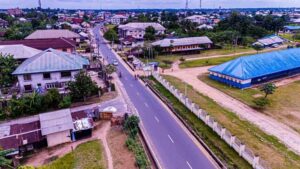
According to Emma Akpabio, The administration has equally expanded opportunities for young people, with Youth-Friendly Centres either completed or under construction in all the local government areas, providing safe spaces dedicated to youth development and essential social services. Already, 100 youths are undergoing intensive training at the first inaugurated hub in Oron.
Even then, the infrastructure story extends beyond the local government areas.
Across all 368 political wards in Akwa Ibom State, at least one Compassionate Home is providing dignity and shelter to vulnerable citizens. Complementing this initiative is the recently approved solar-powered water projects, which will further deepen access to clean and sustainable water in communities across the state.
Without doubt, all these interventions reveal an administration building far more than roads. They reflect a deliberate effort to connect communities, improve public services, expand opportunities and ensure that the dividends of governance are felt from the federal constituencies to the local government areas, and ultimately to all 368 wards of Akwa Ibom State.
These network of super highways, further explains why the recently AKSG purchased 50 CNG buses will afford all Akwa Ibom residents irrespective of location, a new vista, which is access to an improved and affordable transport system across the entire State.
Seen from this perspective, the 39 projects awaiting commissioning this September are not the entire story. They are simply the latest chapter in a much larger unfolding narrative, one that speaks of deliberate planning, balanced development and an enduring commitment to leaving no community behind.