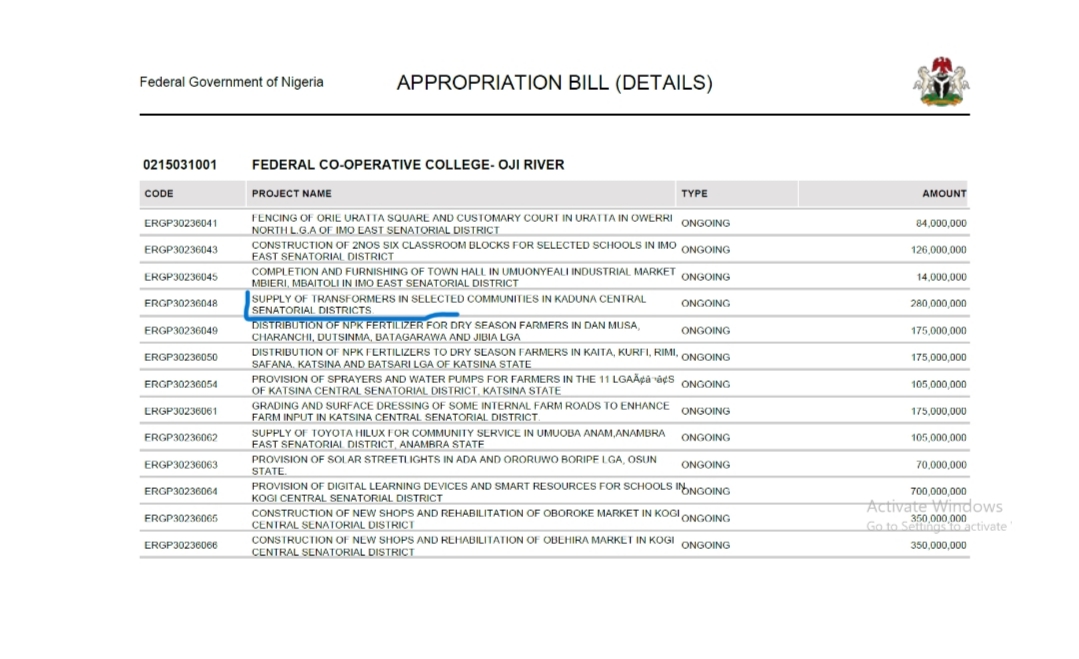
A review of the 2026 Appropriation Act has alleged that the National Assembly approved over ₦29.5 billion for solar street lights, transformers and rural electrification projects under the budget of the Federal Co-operative College, Oji River, Enugu State, despite the institution’s primary mandate being cooperative education and management.
According to an investigative report by SaharaReporters, the college received a total allocation of ₦226.77 billion in the 2026 budget, with ₦225.63 billion earmarked for capital expenditure. Embedded within the allocation are dozens of constituency-style projects involving solar street lights, transformers and rural electrification across several states of the federation.
The report noted that the projects, valued at ₦29.59 billion, span virtually all six geopolitical zones, including Rivers, Anambra, Imo, Cross River, Lagos, Ogun, Kaduna, Katsina, Delta, Ekiti, Oyo, Sokoto, Taraba, Adamawa and other states.
Among the major allocations are ₦1.4 billion for transformer substations in selected rural communities nationwide, ₦1.05 billion for electrification projects in Rivers State, and another ₦1.05 billion for solar street light installations across Ogun State.
Other projects include hundreds of millions of naira for solar street lighting, transformer installations, mini-grid projects, renewable energy systems and rural electrification schemes in various federal constituencies across the country.
The report pointed out that the Federal Co-operative College’s statutory responsibility is to provide academic and professional training in cooperative education and management, with no legal mandate to execute nationwide electrification or public infrastructure projects.
Public finance experts have repeatedly expressed concern over the inclusion of constituency projects in the budgets of government agencies and tertiary institutions without the statutory mandate or technical capacity to implement them. They warn that the practice weakens accountability, complicates oversight and increases the risk of inflated contracts, abandoned projects and mismanagement of public funds.
The report has renewed calls for greater transparency and strict adherence to the constitutional mandates of government institutions in the budgeting and execution of public projects.