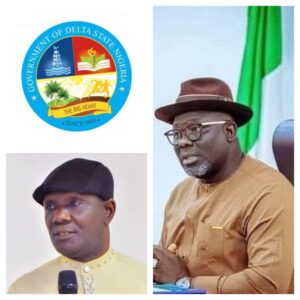
The Director-General of the Delta State Bureau for Orientation and Communications, Dr Fred Latimore Oghenesivbe, has expressed confidence that Governor Sheriff Oborevwori will secure re-election in 2027, predicting that the governor will win in all 25 local government areas of the state.
Oghenesivbe stated this during a special Democracy radio programme monitored in Asaba, attributing his confidence to what he described as the governor’s record of performance, delivery of campaign promises and people-oriented governance since assuming office in May 2023.
According to him, Oborevwori’s administration has recorded unprecedented visible interventions in infrastructure, healthcare, social protection and economic development, which, he said, have strengthened public confidence in the government.
He cited the administration’s extensive road and urban renewal programme as one of its major achievements, especially the Effurun-Warri infrastructure programme, comprising the PTI Junction, DSC Roundabout and Enerhen Junction flyovers, road expansion and related works, awarded at a cumulative cost of about N78 billion. The projects were designed to ease traffic congestion, improve connectivity and stimulate economic activities in the Warri-Effurun axis.
He noted that the administration has subsequently expanded its infrastructure drive to other parts of the state. In 2025, the State Executive Council approved projects worth about N230 billion, including the N59.7 billion Uromi Junction flyover in Agbor and the N39.3 billion Otovwodo Junction flyover in Ughelli, alongside road, healthcare, energy and riverine infrastructure projects, all of which are ongoing and due for commissioning in the near future.
The Director-General further referenced the inauguration of several strategic roads in Warri and other parts of the state, as well as projects such as the Ode-Itsekiri Road and bridges, Ogulaha Bridge, Asaba waterfront roads, Summit Road expansion and the rehabilitation of Nnebisi Road.
He said the administration’s economic interventions were not limited to physical infrastructure, noting that D-CARES intervention programme had also provided direct economic support to hundreds of thousands of Deltans. The programme had reached well over 208,209 beneficiaries, including people supported through cash transfers, public works, livelihood support, community development and MSME interventions.
Oghenesivbe said the government’s investments in healthcare were equally significant, pointing to the procurement of dialysis machines, CT scanners and MRI machines for hospitals across the three senatorial districts. In 2025 alone, eight dialysis machines, 25 ultrasound scanners and two CT scanners were inaugurated, while three MRI machines were approved for major hospitals in Warri, Oghara and Asaba.
He maintained that these interventions, together with ongoing investments in roads, power, education, healthcare and social protection, constitute the foundation for the administration’s M.O.R.E. Agenda and its promise of “Opportunities for All.”
Speaking on the just-concluded Delta State Economic and Investment Summit, Oghenesivbe described the three-day event, held from August 3 to 5, 2026, at The Dome, Asaba, as a deliberate strategy by Governor Oborevwori to reposition the state as a major investment destination.
The summit was held under the theme, “Harnessing Our Strengths, Unlocking Our Potentials,” with discussions and investment opportunities covering the Delta Special Economic Zone, agriculture and agribusiness, solid minerals and mining, energy, tourism and the creative economy, infrastructure, blue economy and transport, human capital, aquaculture, and the digital economy.
Oghenesivbe said the foreseeable gains of the summit include increased domestic and foreign direct investment, expansion of the state’s productive capacity, creation of new jobs, stronger private-sector participation, technology transfer, development of local enterprises and improved government revenue.
He added that investment in agriculture and agribusiness could deepen food production and processing, while opportunities in the Delta Special Economic Zone, energy, solid minerals and manufacturing could accelerate industrialisation and reduce the state’s dependence on crude oil revenues.
According to him, the blue economy and transport-infrastructure opportunities could also unlock the commercial potential of Delta’s coastline and waterways, while investment in the digital economy could create new opportunities for young people in technology, innovation and entrepreneurship.
The summit’s investment focus is significant because Delta’s 2024 GDP was estimated at N16.97 trillion, with the state government’s investment platform identifying the non-oil economy as accounting for about 71.43 per cent of the state’s GDP. The state also has a 163-kilometre coastline, four seaports and substantial gas reserves, providing a broad base for investment beyond crude oil.
Oghenesivbe said the administration had deliberately combined infrastructure development with reforms aimed at improving the business environment. He noted that the government had undertaken reforms in land administration, investment facilitation, public-private partnerships, revenue administration, security and dispute resolution to make Delta more attractive to investors.
He expressed optimism that the real test of the summit would be the conversion of memoranda, commitments and investment conversations into actual projects, factories, businesses, jobs and measurable economic activity across the state.
“The summit has opened the door; what follows is implementation. When these investment opportunities are converted into actual businesses and productive assets, the impact will be felt through employment, increased household incomes, stronger local businesses, improved infrastructure and a broader tax base,” he said.
Oghenesivbe said Delta’s ambition should be to evolve from being primarily known as an oil-producing state into a diversified economic hub driven by agriculture, manufacturing, energy, logistics, technology, tourism and the blue economy.
He further expressed confidence that the investors and strategic partners who participated in the summit would continue discussions with the state government and eventually establish operations in Delta.
On the political front, Oghenesivbe said the APC in Delta State had become bigger and stronger under Governor Oborevwori, following the political realignment that saw the governor and a large section of the former PDP structure join the ruling party in 2025.
He argued that the governor’s performance record, combined with the political strength of the APC structure, had positioned the party for a strong showing in the 2027 elections.
He therefore predicted that Oborevwori would not only win re-election but would record victory across all 25 local government areas of Delta State.