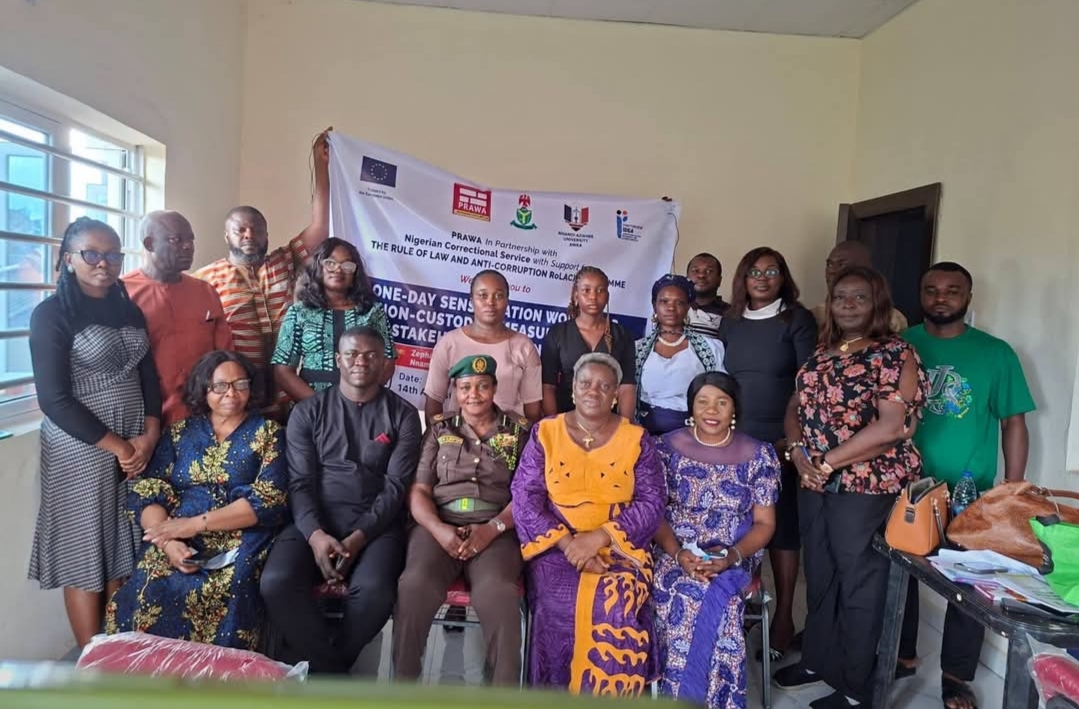
Stakeholders in Anambra State’s justice sector have called for increased funding, stronger institutional support and greater civil society participation to boost the implementation of non-custodial measures and reduce congestion in correctional centres.
The call was made in Awka during a one-day Civil Society Stakeholders’ Meeting on Non-Custodial Measures, organised by the Prisoners Rehabilitation and Welfare Action (PRAWA), in partnership with the Nigerian Correctional Service (NCoS), with support from the Rule of Law and Anti-Corruption (RoLAC) Programme under the Advancing the Implementation of Non-Custodial Solutions (AI-NCS) Project.
The meeting focused on strengthening community-based corrections through the wider use of probation, suspended sentences, community service and parole, while improving the rehabilitation and reintegration of released inmates.
Executive Director of PRAWA, Dr Uju Agomoh, said the effective implementation of non-custodial justice required sustained advocacy, stronger institutional capacity and increased public awareness.
Agomoh also called for greater investment in the training of non-custodial correctional officers to enhance their ability to supervise offenders and coordinate community-based rehabilitation programmes.
She urged civil society organisations to identify areas where they could make meaningful interventions and develop sustainable expertise.
The State Coordinator of RoLAC, Dr Josephine Onah, represented by the State Associate Project Officer, James Osubor, reaffirmed the programme’s commitment to supporting justice sector reforms in Anambra.
She stressed the importance of sustained engagement with the media and other stakeholders to advocate increased funding for non-custodial measures, describing adequate financing as essential to institutionalising the system.
Also speaking, the Assistant Controller of Corrections in charge of the Non-Custodial Unit, Phibina Nneka Ejiofor, said alternatives to imprisonment could significantly reduce congestion in correctional centres while preventing minor offenders from coming into contact with hardened criminals.
She identified probation, parole, community service, restorative justice and other court-ordered alternatives as key components of non-custodial corrections.
Ejiofor, however, identified limited public and judicial awareness, inadequate legal and institutional frameworks, and capacity-building gaps as some of the challenges affecting effective implementation.
Participants at the meeting, which included representatives of civil society organisations, the Nigerian Bar Association, the media and academia, also reviewed relevant provisions of the Nigerian Correctional Service Act, 2019, particularly Sections 12 and 44.
They further examined the proposed Anambra State Correctional Service Bill, stressing the need for its effective passage and implementation.
The stakeholders maintained that expanding credible non-custodial options would not only decongest correctional facilities but also promote rehabilitation, successful reintegration of offenders and a more humane and effective justice system in Anambra State.