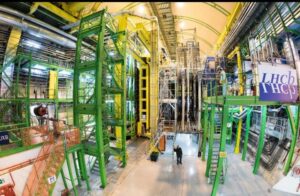
Scientists working with the Large Hadron Collider (LHC) at CERN have reported new evidence of an extremely rare particle decay process that could help improve understanding of the fundamental structure of the universe. The finding, announced on November 17, 2026, represents an important development in particle physics after decades of scientific investigation.
The research was conducted by the LHCb experiment at CERN, the European Organization for Nuclear Research. Scientists observed evidence of a particle known as the B-meson decaying into two muons, a process predicted to occur only once in approximately ten billion decays.
The discovery is particularly significant because scientists have spent several decades investigating this rare process. Its observation provides an opportunity to examine the behaviour of fundamental particles and test existing scientific theories.
According to the research findings, the observation reached a statistical significance of 3.2 sigma. Although this represents important evidence, it is below the five-sigma standard generally required for scientists to officially confirm a new discovery in particle physics.
The findings could help researchers investigate whether the current understanding of particle physics is complete or whether undiscovered particles and physical processes exist.
Scientists believe that continued experiments and additional data from the Large Hadron Collider could provide stronger evidence and improve understanding of the result.
The research also demonstrates the importance of advanced scientific equipment and international collaboration in solving complex questions about the universe.
The development marks an important step in scientific research and demonstrates how years of investigation can contribute to new discoveries. Although further evidence is required, the findings could provide valuable information about the fundamental laws governing the universe.