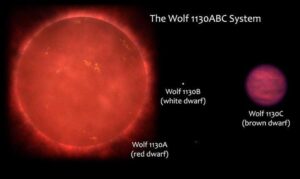
Astronomers have discovered an unusual triple-star system located approximately 28 light-years from Earth, providing scientists with a new opportunity to understand how stars form, interact and evolve.
The system, named Welopō’ai, contains three stars, including one red dwarf and two white dwarfs. White dwarfs are extremely dense remains of stars that have exhausted their nuclear fuel.
The discovery was made by an international team of researchers led by scientists at the Trottier Institute for Research on Exoplanets at the University of Montreal.
Interestingly, the researchers were initially searching for planets outside our solar system when they noticed unusual movements in a nearby red dwarf star. Further observations revealed that the movement was caused by another star rather than an orbiting planet.
Scientists later established that the system contained a third star, making it one of the closest known triple-star systems containing two white dwarfs.
The discovery is particularly important because such systems are rare and provide valuable information about the life cycle of stars and how multiple stars interact through gravitational forces.
Researchers believe that studying the system could help improve scientific understanding of stellar evolution and the formation of complex star systems.
The discovery of Welopō’ai represents an important development in astronomy and demonstrates how continued scientific research can uncover unexpected features of the universe.