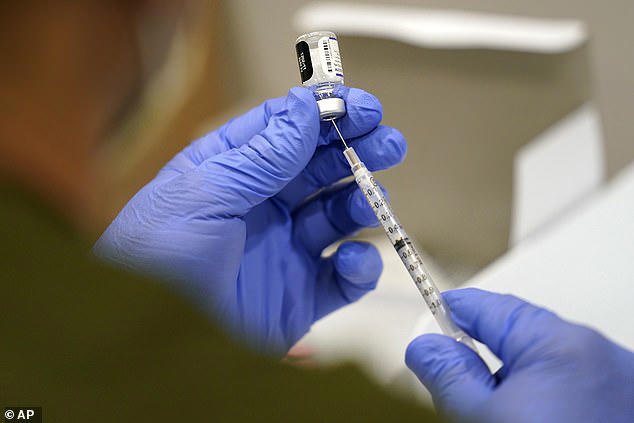
Hundreds of head and neck cancer patients will be given fast-track access to a new ‘transformative’ cancer jab.
The injection targets the advanced form of the disease—which experts believe will herald a new era in fighting the cancer.
It works by boosting the immune system’s response, helping it to ‘attack’ cancer cells containing human papillomavirus (HPV) proteins.
Research has long suggested that HPV may be responsible for up to 70 per cent of head and neck cancers.
The move also marks an expansion of NHS England’s cancer vaccine launch pad programme, which has already allowed over 500 patients to receive bowel and skin cancer vaccines within the last year.
It is estimated more than 100 patients with advanced head and neck cancer will benefit from the jab via the AHEAD-MERIT (BNT113) trial, which will run at 15 hospitals over the next year.
Experts today said the ‘game-changing’ jab offered ‘renewed hope of holding the disease at bay’.
Head and neck cancer is an umbrella term for cancers of the mouth, throat, voice box, nose, sinuses and salivary glands.
HPV is a common virus spread through close contact, including sex, and is usually harmless.
However, in some cases—for reasons not fully understood—it can trigger cancerous changes in healthy tissue.
Despite advances in care for patients with head and neck cancer, the advanced form of the disease is difficult to treat and has high rates of recurrence, with two-year survival rates at under 50 per cent.
The vaccine is designed to create two proteins that are commonly found in head and neck cancers associated with high-risk types of HPV.
NHS England has joined forces with life sciences company BioNTech to help identify potentially eligible patients to refer to NHS hospitals running the trial.
Health minister Karin Smyth described the plan as a ‘massive win for cancer patients’.
She added: ‘These cancer vaccines could be game-changing for patients facing some of the most challenging diagnoses.
‘By getting these trials running in our NHS, we’re putting ourselves at the forefront of medical innovation, improving outcomes for people living with cancer.’
Professor Peter Johnson, national clinical director for cancer at NHS England, also said: ‘It’s fantastic that more patients with advanced head and neck cancers will now be able to access this potentially transformative vaccine, offering renewed hope of holding the disease at bay.’
Chris Curtis was diagnosed with HPV-related head and neck cancer in 2011 and set up a support charity, The Swallows.
The 67-year-old, from Blackpool, said: ‘As a survivor of HPV-related head and neck cancer, I know first-hand the physical, emotional, and psychological toll this disease takes not just on the patient, but on the entire support system around them.
‘With this aggressive cancer you live in the fear of reoccurrence every day—so anything that could help control the disease or give people peace of mind is groundbreaking—it’ll allow people to get on with their lives and move forward.’
Cancers that affect the head and neck are the eighth most common form of cancer overall in the UK, although they are two to three times more common in men than in women.
About 12,500 new cases are diagnosed each year, according to Cancer Research UK, and incidences are on the rise.
Around eight in 10 people will get HPV at some point in their life and their body will clear it without any problems, according to the NHS.
Experts have repeatedly urged people to get the HPV vaccine to reduce their risk of HPV cancers.
Yet, according to the World Health Organisation (WHO), the UK’s HPV vaccine uptake lags shockingly behind other countries — just 56 per cent among girls and 50 per cent for boys.
Denmark, by comparison, records a rate of around 80 per cent.
In the UK, the jab was offered to all girls in school year 8 since September 2008. But eligibility was only expanded to boys in year 8 from September 2019.