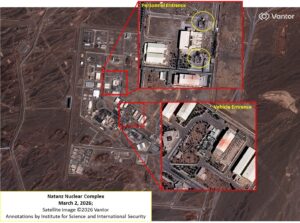
The International Atomic Energy Agency has confirmed that Iran’s underground uranium enrichment facility at Natanz has suffered fresh damage to its surface access points, following recent strikes on the country’s nuclear and military infrastructure.
In a statement, the UN nuclear watchdog said its assessment of new satellite images showed “new damage to the entrance structures” of the fortified complex but stressed that “no radiological consequences are expected.”
According to the agency, the images reveal visible impact on above‑ground structures connected to the underground halls where centrifuges are installed, suggesting that the attack was aimed at access routes and support infrastructure rather than directly at the enrichment halls themselves.
Inspectors and technical analysts are continuing to review the extent of the structural damage, but the IAEA underlined that there is no indication of a release of radioactive material from the site and that surrounding communities are not at immediate risk. The agency added that it remains in contact with Iranian authorities and is seeking further clarification and on‑site access as soon as security conditions allow.
Natanz is one of the most sensitive and heavily monitored elements of Iran’s nuclear programme, housing thousands of centrifuges in underground bunkers designed to protect them from airstrikes. Damage to entrance structures and surface facilities could complicate logistics, maintenance and movement of personnel and equipment, even if the core enrichment capability inside the underground halls remains intact.
Analysts say such strikes are often designed to slow operations, increase repair and security costs and send a strategic signal, rather than trigger a nuclear safety emergency.
The IAEA’s assurance that no radiological consequences are expected is intended to calm fears of environmental contamination in Iran and neighbouring countries, at a time of heightened regional tensions and military escalation.
However, the incident is likely to intensify diplomatic pressure and debate over Iran’s nuclear activities, the safety and security of its nuclear sites in a conflict environment, and the future of international monitoring arrangements.
The agency is expected to brief member states in the coming days, as governments watch closely for any sign that the damage at Natanz could affect Iran’s enrichment capacity or its cooperation with international inspectors.