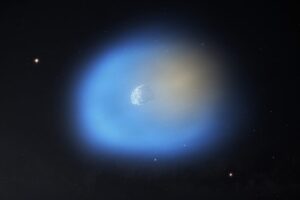
Astronomers have discovered that interstellar comet 3I/ATLAS is one of the most methanol‑rich comets ever observed, revealing an alien chemistry unlike anything typically seen in our own solar system.
Scientists using the Atacama Large Millimeter/submillimeter Array (ALMA) in Chile detected exceptionally high levels of methanol in gas streaming from 3I/ATLAS as it passed through the inner solar system in late 2025. Detailed measurements showed that the ratio of methanol to hydrogen cyanide in the comet’s coma ranged between about 79 and 124, values that place 3I/ATLAS among the most chemically enriched comets on record and second only to the unusually active solar‑system comet C/2016 R2 (PanSTARRS).
The observations also revealed that methanol and hydrogen cyanide are not escaping the comet in the same way. Hydrogen cyanide appears to originate mainly from the nucleus, while methanol is released both directly from the core and from tiny ice grains embedded in the surrounding coma, which act like miniature comets as they warm in sunlight. This dual source of methanol, traced over distances greater than roughly 258 kilometers from the nucleus, offers rare insight into how volatile ices formed and are stored around another star.
The new methanol map builds on earlier results from the James Webb Space Telescope, which found that 3I/ATLAS has a coma dominated by carbon dioxide with an unusually high CO₂‑to‑water ratio, and on subsequent space‑based observations that detected water, methane, methanol and cyanide released in a delayed outburst months after perihelion. Taken together, these findings point to a comet forged in a cold, chemically rich region of its home system, carrying abundant ingredients associated with prebiotic chemistry.
Discovered on July 1, 2025, by the NASA‑funded ATLAS survey in Chile, 3I/ATLAS is only the third confirmed interstellar object known, after 1I/ʻOumuamua and 2I/Borisov. The comet passed safely through the inner solar system at a distance of about 170 million miles from Earth and is now receding past Jupiter’s orbit on its way back to interstellar space, leaving behind the most detailed chemical fingerprint yet of material born around another star.