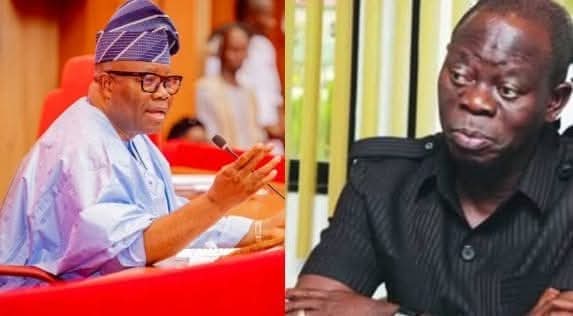
The Senate chamber erupted into disorder on Wednesday as Senate President Godswill Akpabio and Senator Adams Oshiomhole clashed fiercely over the interpretation of newly amended standing rules, forcing proceedings to descend into confusion for over 15 minutes.
Trouble began when Akpabio started reading the Votes and Proceedings of the previous day. Oshiomhole (APC, Edo North) immediately raised a point of order, but the Senate President ruled him out, citing Senate Standing Order 2023 (as amended), which disallows points of order during the reading of votes and proceedings.
Despite repeated warnings, Oshiomhole persisted, prompting intervention from other senior lawmakers, including Senator Orji Uzor Kalu, who reinforced Akpabio’s ruling that the point of order was out of place at that stage.
The tension escalated further when the Senate Whip, Senator Tahir Monguno, warned Oshiomhole to comply with the rules or face disciplinary measures.
At the peak of the confrontation, Akpabio delivered a stern caution to the former APC national chairman, warning him against continued disruption.
“We should not just go home, buy forms and come here without knowing the rules.
He then issued a strong warning to Oshiomhole, cautioning him against further disruption.
“Oshiomhole, if you become unruly, we will use the rules to take you out of the Senate,” he said.
Despite the tension, order was eventually restored after sustained interventions from lawmakers.
Senator Adamu Aliero moved for the adoption of the Votes and Proceedings, which was seconded by Senate Minority Leader Senator Abba Moro, bringing the sitting to a close.
The confrontation is believed to be linked to the Senate’s recent amendment of its standing rules, which reportedly tightens eligibility for key leadership positions ahead of the 2027 political cycle.
The amended provisions, adopted after a closed-door session, restrict eligibility for Senate presidency to ranking lawmakers and those who have served at least two consecutive terms immediately preceding nomination.
The changes are seen as part of efforts to enforce ranking traditions and limit the contest for presiding offices to experienced lawmakers.
However, critics say the move could exclude several serving and incoming senators from leadership ambitions in the 11th National Assembly.
The revised order emphasises strict ranking criteria for leadership positions and narrows eligibility for Senate principal offices such as Senate President, Deputy Senate President, and other top leadership roles.
It further states that only senators with continuous service experience immediately preceding nomination will qualify for contesting leadership positions.
The altercation highlights rising political tension within the upper chamber as lawmakers adjust to new rules that may reshape power dynamics ahead of the next general elections.
With tempers flaring on the floor and new restrictions stirring controversy, the Senate appears set for more internal battles in the months ahead.