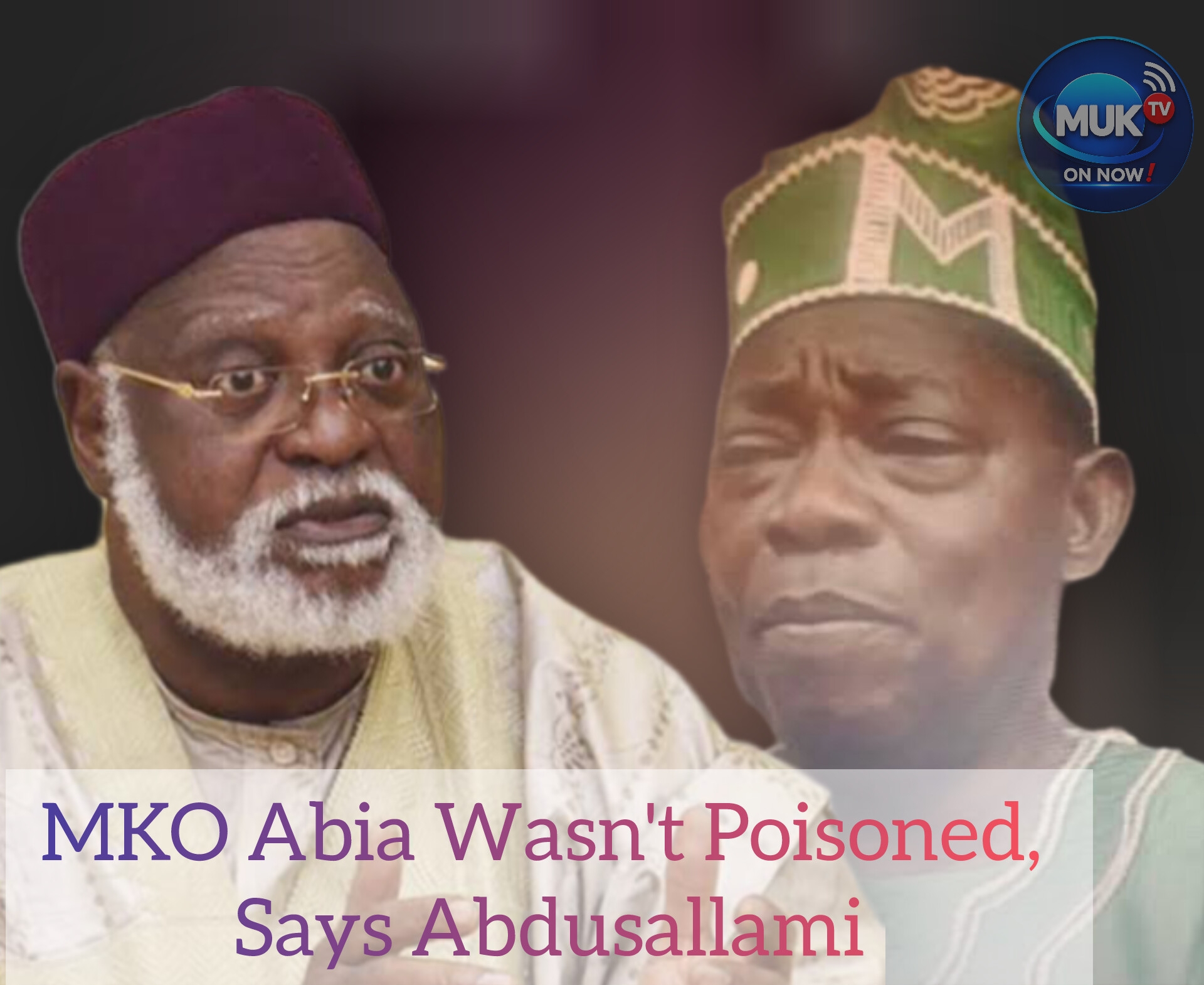
Former Head of State, Gen. Abdulsallami Abubakar (retd.), has dismissed longstanding allegations that Chief MKO Abiola was poisoned, maintaining that an autopsy conducted by pathologists from four countries concluded that the presumed winner of the June 12, 1993 presidential election died of natural causes.
Abubakar made the revelation in his autobiography, Call of Duty, unveiled on Saturday during events marking his 84th birthday at the Aso Rock Villa, Abuja.
According to the former military leader, Abiola collapsed on July 7, 1998, during a meeting with a visiting American delegation that included Mr. Tom Pickering, then U.S. Undersecretary of State for Political Affairs, and Ms. Susan Rice, then Assistant Secretary of State for African Affairs.
Addressing persistent claims that Abiola was poisoned, Abubakar wrote, “I do not believe Abiola was poisoned. The family requested an autopsy and we assembled American, British, Nigerian and Canadian pathologists to conduct it. The autopsy report attributed his death to natural causes.”
He further disclosed that Abiola had been battling underlying health conditions, including hypertension and a heart-related ailment, long before his detention.
“As far back as 1994 when he was arrested by the Abacha Administration for declaring himself President, it was public knowledge that Abiola was managing certain medical conditions which could seriously affect the quality of life of any human being.”
Abubakar cited a radiological report prepared in September 1994 by Colonel (Dr.) O. Awofeso, then Chief Consultant Radiologist at the Nigerian Army Defence Hospital, Sokoto, which reportedly showed that Abiola’s heart was enlarged and consistent with hypertensive cardiac disease.
Drawing from Susan Rice’s memoir, Tough Love: My Story of the Things Worth Fighting For, Abubakar recounted the final moments before Abiola’s collapse.
“Rice said she noticed Abiola’s ankles were swollen. About five minutes into their conversation, according to her, ‘Abiola started to cough, at first mildly and intermittently, and then wrackingly with consistency,’”
He stated that Abiola subsequently complained of feeling hot and requested that the air conditioner be turned up. A doctor was later summoned and diagnosed a heart attack.
Abubakar also quoted Pickering’s account of the incident, describing how Abiola’s condition rapidly deteriorated.
“had trouble breathing, went into the toilet and came out obviously very distressed,”
According to Pickering, “A doctor arrived within 10 minutes and called for immediate hospital attention.
“We all helped to put him in a car, there was no ambulance immediately available. We followed him to the clinic of the Head of State of Nigeria, where doctors immediately began to work on him…but unfortunately at the end of their efforts it was not possible and he died,”
Recalling how he received the tragic news, Abubakar wrote, “Aliyu, my CSO, called me. As soon as I picked, he said, in a shaky voice, that there was a problem. I asked: ‘What problem again?’ He said Abiola was dead. My head went blank,”
The former Head of State said informing Abiola’s family of his death was one of the most difficult moments, noting that one of Abiola’s daughters broke down in tears and was comforted by Susan Rice.
Reflecting on the circumstances surrounding the meeting, he stated, “If we had not allowed the American delegation to see him and he had died in custody, it would have been a different story. It would have been insinuated that he had long died and we were trying to cover it up,”
Abubakar also used the opportunity to dismiss allegations that he received $500 million in cash after the death of Gen. Sani Abacha, describing the accusation as completely unfounded.
“I want to put it on record that nobody gave me $500 million or any amount, bigger or smaller.
“Is it possible to collect half a billion dollars in cash and only one person in the world would know about it?”
Abiola, widely regarded as the winner of the annulled June 12, 1993 presidential election, had remained in detention since 1994 after declaring himself President.
His death, coming barely a month after the passing of Gen. Sani Abacha, sparked widespread speculation and conspiracy theories over the years.
However, Abdulsalami insists that medical evidence and the multinational autopsy conducted after Abiola’s death point firmly to natural causes rather than foul play.
Abubakar later supervised Nigeria’s transition from military to civilian rule, handing over power to President Olusegun Obasanjo on May 29, 1999.