Burkina Faso has opened its first national gold refinery as President Ibrahim Traoré’s government steps up efforts to strengthen state control over the country’s gold industry and retain more of the mineral’s economic value within the country.
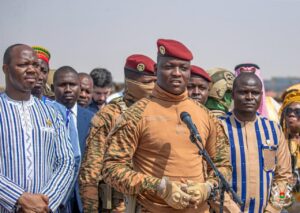
Traoré inaugurated the National Gold Refinery of Burkina Faso, known as RAFFINOR-BF, in Ouagadougou on Monday, September 28. The facility is part of a broader government drive to develop more of the country’s mining value chain domestically rather than exporting raw or semi-processed minerals for treatment abroad.
The refinery was built at a cost of more than 11 billion CFA francs, approximately $19 million, and has an initial processing capacity of 164 tonnes of gold annually. Authorities say the capacity could eventually be increased to 515 tonnes a year.
The facility will process gold from both industrial and artisanal mining operations, while also providing assaying, certification and secure storage services. During the inauguration, officials presented the first gold bar refined entirely within Burkina Faso.
Burkina Faso produced more than 94 tonnes of gold in 2025, making the mineral one of the country’s most important sources of export earnings. Historically, a significant portion of the country’s gold has left in doré form for refining and certification in other countries, allowing part of the downstream value generated by the resource to be captured outside Burkina Faso.
Traoré has increasingly placed economic sovereignty and greater state involvement in the mining sector at the centre of his administration’s economic agenda.
At the inauguration, the president said Burkina Faso should move beyond simply extracting its natural resources and sending them abroad. His government has instead promoted the development of a domestic value chain covering extraction, processing and commercialisation.
The push comes as Burkina Faso continues to face a severe security crisis while seeking to increase state revenues. Gold mining remains central to the economy, with production coming from large industrial operations as well as thousands of artisanal and smaller-scale miners.
Authorities have taken several steps to increase government oversight of the sector, including expanding the role of state-owned mining companies, taking control of certain mining assets and introducing tighter regulations around artisanal mining and gold exports.
Another major concern is gold smuggling. Burkina Faso has repeatedly raised concerns about gold leaving the country through informal channels, potentially reducing government revenue and making it difficult for authorities to accurately track production and exports.
The country’s security challenges have further complicated efforts to regulate the industry. Large parts of Burkina Faso have experienced attacks by jihadist groups, while informal mining and cross-border gold trading have created additional challenges for government oversight.
The new refinery could provide authorities with an additional point of control. Gold entering the formal system can be weighed, tested, certified and stored domestically before being placed on international markets.
This could provide authorities with better information about the volume and origin of gold entering the formal trade and potentially improve revenue collection.
However, the refinery alone will not resolve the challenges facing Burkina Faso’s gold sector. Its impact will depend largely on how much domestic production is channelled through the facility, whether more artisanal miners can be brought into the formal economy and how effectively authorities can combat illicit gold trading.
The refinery’s initial annual capacity of 164 tonnes is already significantly above Burkina Faso’s reported 2025 production of more than 94 tonnes. The proposed expansion to 515 tonnes, however, indicates that the government is planning for increased production and potentially a larger domestic and regional gold-processing industry.
Burkina Faso’s move is also part of a broader push across Africa to process more natural resources locally and capture greater downstream economic value. Rather than exporting minerals for processing elsewhere, governments across the continent have increasingly sought to establish domestic processing and refining capacity.
For Traoré’s government, the refinery carries an additional significance. It represents an attempt to turn the country’s gold resources into a larger source of domestic economic value and state revenue.
The refinery is now operating in Ouagadougou. Its longer-term impact will depend on whether Burkina Faso can successfully channel more of its gold production through the formal system, reduce illicit exports and develop the wider infrastructure needed to retain more of the wealth generated by one of the country’s most important natural resources.