FORMER President Goodluck Jonathan’s damning, but accurate, observation that Nigeria records the lowest voter turnout among the many elections he has monitored across Africa and beyond should trouble every patriot. It is even more alarming now that the country is preparing for another general election cycle next January.
This is not merely an electoral concern; it is a national setback that demands urgent and radical intervention.
For a leader who has monitored elections in more than 15 countries since leaving office in 2015, Jonathan’s verdict is more than a lamentation. It is a grim diagnosis of a democracy steadily bleeding public confidence.
Concerted efforts must therefore be made to reverse the trend before voter apathy fatally undermines the 2027 elections.
Nigerians face a defining choice next January: either transform the polls into a democratic turning point or continue with the ruinous cycle of business as usual.
Jonathan said, “I have observed elections in about 14 African countries and some more than two times and some countries in South-East Asia. Nigeria has the lowest turnout in elections in every election cycle.
“We have the worst voter apathy. It seems people are not even interested in their elections. We have the least (participation). I have never been to a country with the low numbers that we have. INEC needs to study it and find out what is wrong, what is the cause, and do something about it.”
The roots of voter apathy in Nigeria are deep and corrosive: vote buying, electoral violence, rigging, falsification of results, voter suppression, constitutional loopholes, INEC incompetence, politicians’ desperation, and the often-indifferent posture of security agencies.
Together, these failures reinforce the dangerous perception that votes do not count, pushing citizens away from the ballot box.
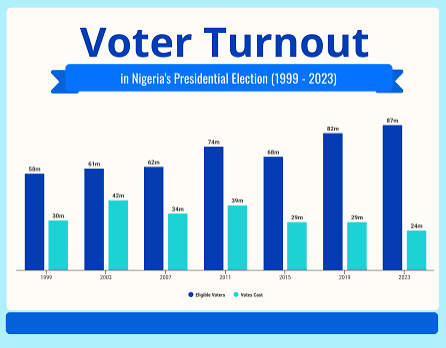
Low voter turnout has become a national malaise. The 2023 general elections produced perhaps the bleakest electoral profile in Nigeria’s democratic history.
Although 87.20 million voters collected PVCs out of the 93.46 million who registered, largely for identification purposes rather than civic participation, only 24.9 million voters, representing 26.72 per cent, eventually voted in the presidential and National Assembly elections.
That was the lowest turnout since 1999. President Bola Tinubu assumed office with 36.61 per cent of the votes cast.
INEC data shows that voter turnout in general elections has declined steadily since 2007.
According to the electoral umpire, voter turnout stood at 57.54 per cent in 2007, fell to 53.68 per cent in 2011, dropped further to 43.65 per cent in 2015, slid to 34.75 per cent in 2019, and crashed to 26.72 per cent in 2023.