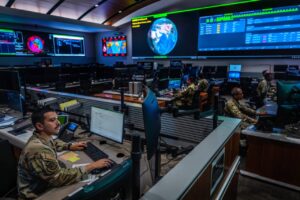
The United States has publicly acknowledged for the first time that it has weapons deployed in orbit, marking a significant shift in Washington’s approach to military operations beyond Earth.
US Air Force Secretary Troy Meink disclosed the development on Monday during the Air, Space & Cyber Conference in National Harbor, Maryland. He said the country now possesses “on-orbit space control weapons” designed to protect US military forces from hostile actions by adversaries.
Meink did not reveal the number of weapons currently in orbit, when they were launched or the specific capabilities they possess. He also declined to confirm whether the systems had undergone testing.
The official said the decision to acknowledge the weapons was deliberate, noting that the wording used in his announcement had been carefully considered.
According to Meink, maintaining US superiority in space has become increasingly important as countries such as China and Russia develop capabilities that could threaten American satellites and other space-based systems.
The disclosure is notable because Washington has previously spoken extensively about threats to its satellites without confirming that comparable US weapons were already operating in orbit.
The phrase “space control” covers a wide range of military capabilities. The US Space Force describes it as the ability to contest and control activities in the space domain through kinetic and non-kinetic means.
Such capabilities could include systems designed to disrupt satellite operations electronically, as well as weapons capable of physically damaging or destroying spacecraft. However, US officials have not specified which capabilities are currently deployed.
Meink also indicated that much of the information surrounding the systems would remain classified. He argued that revealing their capabilities or operational details could compromise their effectiveness.
The deployment is primarily being presented as a deterrent. The US military relies heavily on satellites for communications, intelligence gathering, navigation and missile warning, making space infrastructure essential to operations on Earth.
American officials have repeatedly warned that China and Russia are developing technologies capable of interfering with or attacking US satellites. The latest disclosure suggests Washington is seeking to ensure it has the ability to respond if those systems are targeted.
However, the development has raised concerns about a potential arms race in space.
The deployment of weapons by one major power could encourage others to develop similar capabilities, increasing competition between the United States, China and Russia over military dominance in orbit.
China has criticised the move, calling on Washington to oppose the militarisation of outer space and warning against turning space into a battlefield.
The development also comes as the US Space Force, established in 2019, continues to expand its role in preparing for potential conflicts involving space-based infrastructure.
Modern military operations depend heavily on satellites, with GPS, secure communications, surveillance and missile-warning systems all relying on space-based assets. Any major disruption could therefore have consequences for military forces operating on land, at sea and in the air.
International law also leaves significant room for military activity in space. The 1967 Outer Space Treaty prohibits the placement of nuclear weapons and other weapons of mass destruction in orbit but does not impose a comprehensive ban on conventional weapons or military operations in space.
The US disclosure therefore signals that the military competition surrounding space is moving beyond planning and capability development, with at least some American weapons now confirmed to be operating above Earth.
While Washington has withheld details about the systems, their numbers and locations, the announcement sends a clear message to its strategic rivals that the United States intends to defend its position in space and respond to potential threats against its space-based assets.