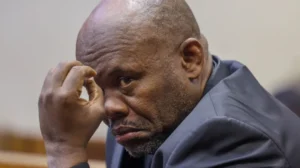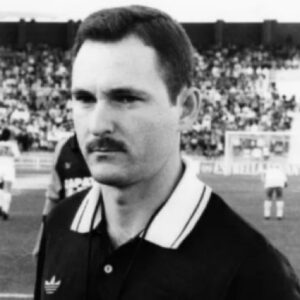
Tristante Oliva (former Spanish referee): “In 2004, I gave Real Madrid a penalty vs Valencia in the 91st minute.
To me, it was a clear and obvious penalty, Marchena had blocked Raúl with his arm and leg inside the penalty area.
I finished the match happy, but afterward I called home and everyone was telling me there had been a huge fuss about the penalty. Something completely disproportionate.
The news programs were leading with the play. That’s something that’s never been seen before. It was very hard for me.
I didn’t feel the support of the Technical Committee of Referees at any point. The support that other referees had, I didn’t get.
And at the end of the season, I was relegated from La Liga and I was never allowed to officiate another La Liga game again.
Other referees complain and say that their children are insulted at school because of their father, but then those children can say that their father is still refereeing at the Camp Nou, the Bernabéu, or San Mamés.
My children couldn’t say that because I was relegated at the end of the season. Because of that penalty, I was automatically sidelined.
Back then, referee assignments were made by computer. So, despite the mess that ensued, I was able to referee the three or four matches the computer had decided on. That at least allowed me to finish the season.
Two days after the match there were some physical tests for the team, and as I was heading towards the training grounds, it was as if a conversation between the president of the Referees Committee, Sanchez Arminio, and the vice-president, Enríquez NEGREIRA, had been interrupted.
They were talking about the penalty. They saw me and said, “Come on, relax, forget about it, and just get through the tests.”
But as I walked away, I heard Negreira say to Sánchez Arminio, “This is what’s wrong with the computer. We should take it down.”
When I heard that, I thought to myself, “You’re finished, man. They’re going to make you the scapegoat.”
They didn’t like the computer system because it prevented them from managing the appointments themselves.
Valencia protested, and with all the commotion that ensued, they got rid of the computer system, which is what they wanted.
My feeling was that the support other referees received for very clear mistakes… Not only did nothing happen to them, but the support was enormous.
They refereed Cup finals, they were given international caps… and I was sent home.
Referee Rodríguez Santiago allowed a clear handball goal by Messi in 2007, and a week later they choose him to officiate the Copa del Rey final?
I, naive as I was, thought that if I’d allowed a handball goal in such a crucial match, I was going to have trouble saving myself.
A handball goal was the example they always gave us to show that you’d never have the support of the Technical Committee of Referees. The most severely punished mistake. It’s not a minor infraction.
They’d tell you, “As long as you don’t let in a handball goal, you’re all set.”
Look, I’m happy for Rodríguez Santiago, because I have nothing against my former colleagues. But I never thought they’d give him the Cup final. That threw you off.
And then you see the double standards, like with me.
The problem was the absolute power of the Technical Committee of Referees with the Correction Factor…
In the jargon, we called it THE CORRUPTION FACTOR.
The Correction Factor is like if a team wins the league in June, but two or three people get together and decide that the leader should be relegated to fourth place, so they can’t win the title even if they appeal, and that another team should win it because we like them better or for whatever reason.
That’s unthinkable, but that’s what the CTA (Technical Committee of Referees) did with the referees. With their power, they could promote or demote you with that wildcard at will. Those who protested were out.
They had everything under control. If you didn’t keep quiet, you were finished. A player can change teams, but not here because there’s only one CTA. If they blacklist you, you’re finished…
Did Negreira have power and influence?
OF COURSE he did. Ninety percent of the time, he was the one who told us at the end of the season which league we’d officiate in. In the physical tests, your main goal was to be told you were doing well. Because otherwise, you knew what was coming.
Negreira was the one who greeted you, you stood in front of him, and with some notes he had, he’d tell you if you’d done better or worse in this match or another. And he’d tell you if you were in group 1, group 2, group 3… He definitely had the power because he was the one who told us.
He certainly had the power to promote and demote you.
He wasn’t just some figurehead. He wielded considerable influence.
The Negreira scandal?
I was SHOCKED, it’s something unheard of. I didn’t agree with that CTA at all, but it still surprised me.
It never crossed any of our minds that Negreira was being paid by a club. It’s surreal, unbelievable. I couldn’t believe it.
But that’s the way it is, and little by little I’ve been coming to terms with it, with anger. I’m sure there have been many victims along the way to justify those payments.
The CTA trying to downplay the scandal now?
That surprises me too. Many referees have had those experiences. It’s easier for me to talk about it now that I’m on the outside, because when you’re on the inside, they know that if you step out of line, it’s all over for you.
Referees don’t have any freedom. My experience was proof of that. I couldn’t even say goodbye properly.
Everything here is decided by favoritism. Nobody dares to say anything. Only in private.
The mere fact that you, as vice president, received that amount of money from a club should be punishable in itself. It’s common sense. How is it possible to receive payment from a club?
A punishment would be a relief to many people and many referees, not just retired ones. The matter should be resolved in an exemplary manner.”