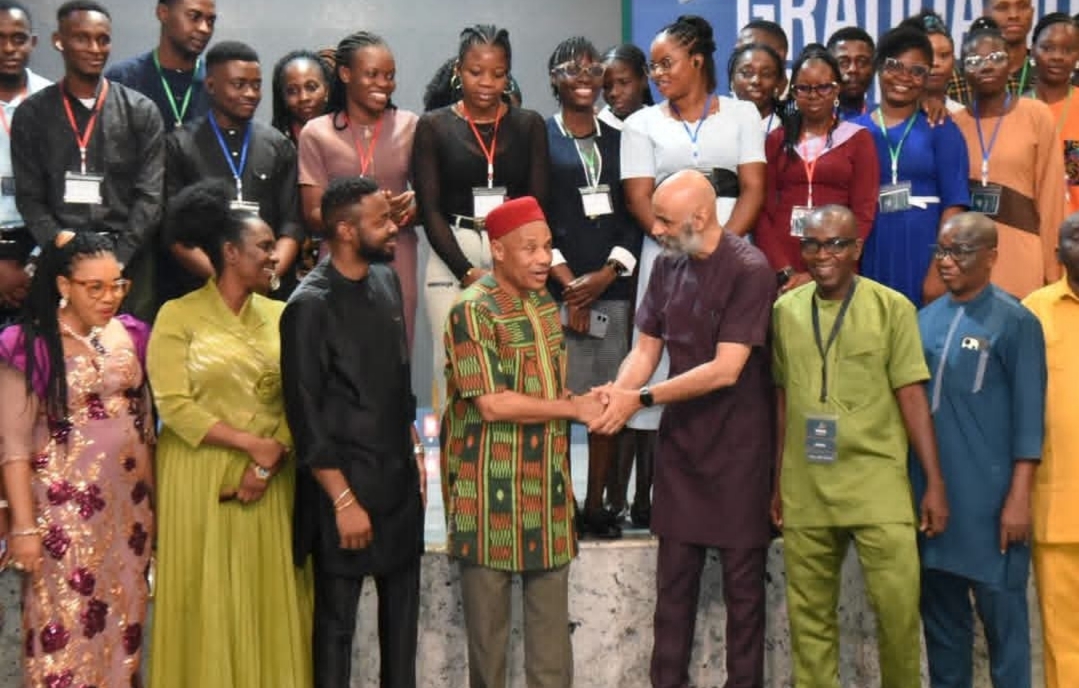
Abia State Governor, Dr Alex Otti, has challenged the 100 pioneer graduates of the ThriveAbia initiative to use their newly acquired digital skills to empower other young people, develop innovative solutions, and contribute to the state’s economic growth.
Otti gave the charge on Saturday, October 10, 2026, during the graduation ceremony of the programme’s maiden cohort at the Michael Okpara Auditorium in Umuahia.
Represented by the Secretary to the State Government, Dr Emmanuel Meribeole, the governor described the graduates as potential innovators, entrepreneurs, problem-solvers, and ambassadors of a new Abia.
He said the initiative reflects his administration’s commitment to human capital development as a foundation for sustainable prosperity.
The governor urged the graduates to become multipliers of opportunities by mentoring and training others, noting that if each of the 100 beneficiaries trained 10 additional young people, the programme could indirectly empower another 1,000 people.
He challenged them to return to their communities, share their knowledge, and ensure the programme’s impact reaches all 17 local government areas of Abia State.
Otti emphasised that his administration views investment in human capital not as an expenditure but as an investment in the state’s future.
He also encouraged young people to take advantage of digital opportunities available across the world, regardless of their location.
According to him, a software engineer in Umuahia can work for a company in London or the United States, while a graphic designer in Aba can serve clients in New York and a digital entrepreneur in Ohafia can provide solutions across Africa.
The governor urged the graduates to remain in Abia, build their careers, innovate, and contribute to the state’s development, adding that investments in infrastructure, education, institutional reforms, and economic development form part of his administration’s broader vision for a competitive and prosperous state.
In his welcome address, the Commissioner for Science, Technology and Innovation, Dr David Kalu, said ThriveAbia was designed to go beyond conventional training by incorporating mentorship, critical thinking, problem-solving, teamwork, and professional development.
“Our objective was not simply to produce trainees. Our objective was to produce talent,” Kalu said.
He disclosed that the programme had also explored pathways connecting training with practical work experience, including a pilot internship initiative involving a global cybersecurity and technology company.
According to him, the process includes engagement with companies, collection of beneficiaries’ curricula vitae, candidate screening, interview follow-ups, and tracking placement progress to help qualified participants access internship opportunities.
Kalu reminded the graduates that ThriveAbia operates on a train the trainer model, requiring beneficiaries to mentor others and help prepare future participants.
He urged them to sustain the discipline developed during the programme, demonstrate their acquired skills, and maximise available opportunities.
Also speaking, an implementation partner and co-founder of Tech Excentric and Curate, Mr Gilbert Igwe, commended the initiative, saying it had equipped participants with skills that could enable them to earn income locally and internationally.
Igwe expressed gratitude for the collaboration between the state government and private organisations, describing the partnership as an example of how cooperation could produce tangible results.
He further claimed that more than 50 per cent of the graduates were already earning in dollars or employed, while some had begun training others.
In their testimonies, beneficiaries, including pharmacy graduate Emmanuel Bright Ijioma, biochemist Okwu Godwin Emeka, and Elizabeth Okwara, thanked the state government for the opportunity.
They said the programme had improved their ability to use technological tools in their respective fields, adding that the mentorship and digital skills training had helped them establish connections for potential remote-work opportunities.
The graduates appealed to the state government to sustain the initiative so that more young people could benefit.
The ceremony attracted government officials, including the Principal Secretary and Chief Strategy Officer of the state, Mr Chinenye Mba-Uzoukwu, and the Permanent Secretary of the Ministry of Science, Technology and Innovation, Engineer Justin Ebo.
The graduates also demonstrated skills acquired during the programme and received certificates of completion.
By Enitan Mudashiru | MUK TV News