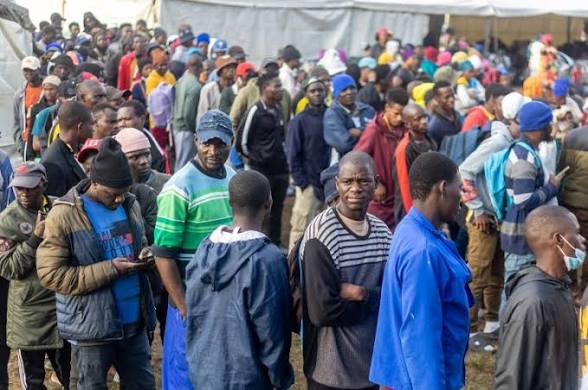
As Rafiu Wasiu disembarked from the aircraft at the Murtala Muhammed International Airport in Lagos on Thursday, his face reflected a mix of emotions. While he was relieved to be back home, he appeared downcast by the circumstances that forced his return.
Wasiu, a mechanic who spent years working in South Africa, was among 268 Nigerians who arrived the country aboard a government-facilitated evacuation flight. They returned not as visitors, but as people who had fled what they described as escalating xenophobic attacks, intimidation and economic exclusion.
The returnees, many of whom had lived in South Africa for years, came back with stories of fear, loss and abrupt displacement. Several said they left behind businesses built over time, while others abandoned families, homes and investments. For many, the decision to return was not voluntary, but driven by what they described as rising hostility and insecurity.
“They treated us like animals”
Recalling his experience, which he described as traumatic, Wasiu stated that foreigners, especially Nigerians and other Africans, had become targets in many communities.
“I’m so happy right now. I’m glad to be returning home safely. They started the attacks alongside warnings that we should leave the country,” he said.
According to him, the violence was often sudden and unprovoked.
“You can just see them on the street calling you. They will say, ‘Hey, come here, let me have your phone.’ If you resist, they bring out a knife and stab you. And, the police will do nothing,” he said.
He also alleged that foreigners were routinely singled out and mistreated.
“These are black South Africans. They treat us like animals. They don’t have any regard for us,” he added, while noting that most migrants were engaged in small-scale trade and informal work.
Accusing law enforcement officers of extortion, Wasiu said, “Two weeks ago, I was sitting with my friend when the police came. They picked him up and we had to pay 2,500 rand to secure his release,” he said.
He further claimed that officers often used different and flimsy methods to get migrants to part with their money.
“Police will stop you on the road. Once they see money on you, they will say somebody has Mandela’s head here because Mandela’s picture is on the currency. Then they take your money,” he alleged.
Now back in Nigeria, Wasiu said he is focused on rebuilding his life.